
Lean & Evidence-Based Leadership for the AI Era.
Leadership in times of instability—marked by pandemics, economic recession, and geopolitical crises—must address the team’s profound sense of instability, isolation, and lack of influence.
To foster collective resilience and a sense of purpose, I advocate for “Lean & Evidence-Based Leadership.” This approach relies on a specific set of tools designed to achieve two primary goals: giving a sense of meaning (purpose) and building a culture of teamwork based on trust and diversity.
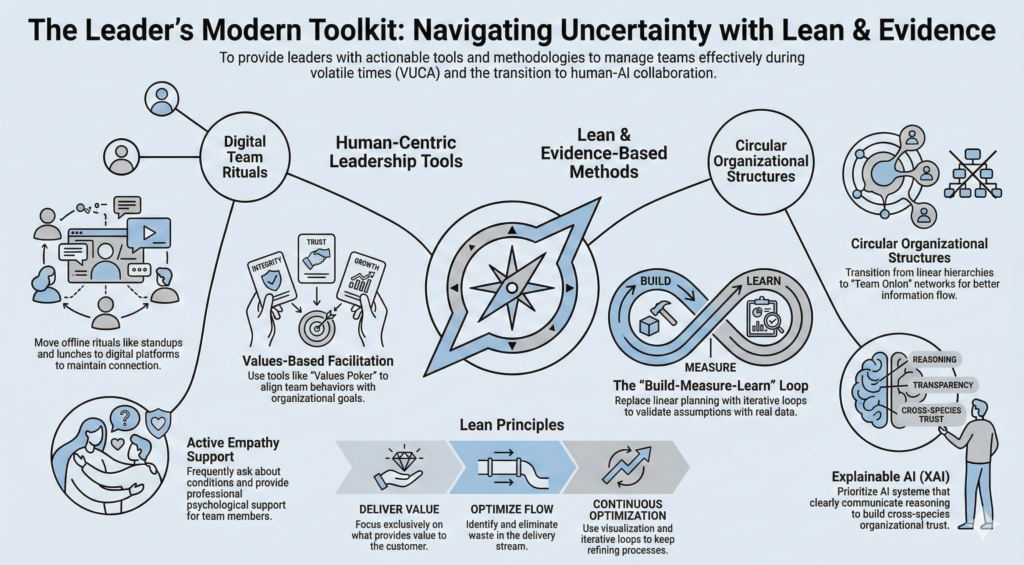
Here are the specific leadership tools and strategies:
1. Tools to Build Purpose and a Sense of Influence
A major cause of resignation and burnout is the feeling of powerlessness regarding external events (inflation, war). Leaders can counter this by maximizing the team’s influence over their immediate professional environment through transparency and participation.
- Shared Vision and Values (Iterative): Instead of static mission statements, leaders should employ a Shared Vision that is validated iteratively—potentially as often as every month in dynamic environments—to ensure the team knows where they are heading. Similarly, Shared Values should be actively discussed and validated using tools like Values Poker, ensuring they remain relevant to the team’s current reality.
- Strategic Workshops and Regular Reviews: To maintain focus on the “North Star,” leaders should conduct Strategic Workshops for roadmapping. Crucially, this must be supported by Strategic Weekly & Monthly meetings that review the Business Model Canvas. This helps the team see how their specific work connects to broader areas like sales, marketing, and costs.
- The Balanced Scorecard: To visualize progress, leaders should use a Balanced Scorecard available to the whole team. This should track not just financial results but also internal processes, customer metrics, and team capacity (including retention and Net Promoter Score), giving a holistic view of the company’s health.
- Transparent Pricing: Leaders should educate the team on Transparent Pricing models. By understanding how their work translates into company revenue and costs, team members gain a concrete sense of the value they generate.
2. Tools to Foster Collective Resilience and Relationships
Resilience is rooted in the “Village Effect”—the idea that strong social relationships and face-to-face communication are key to longevity and well-being. To build this “village” within a team, leaders should use tools that humanize the workplace.
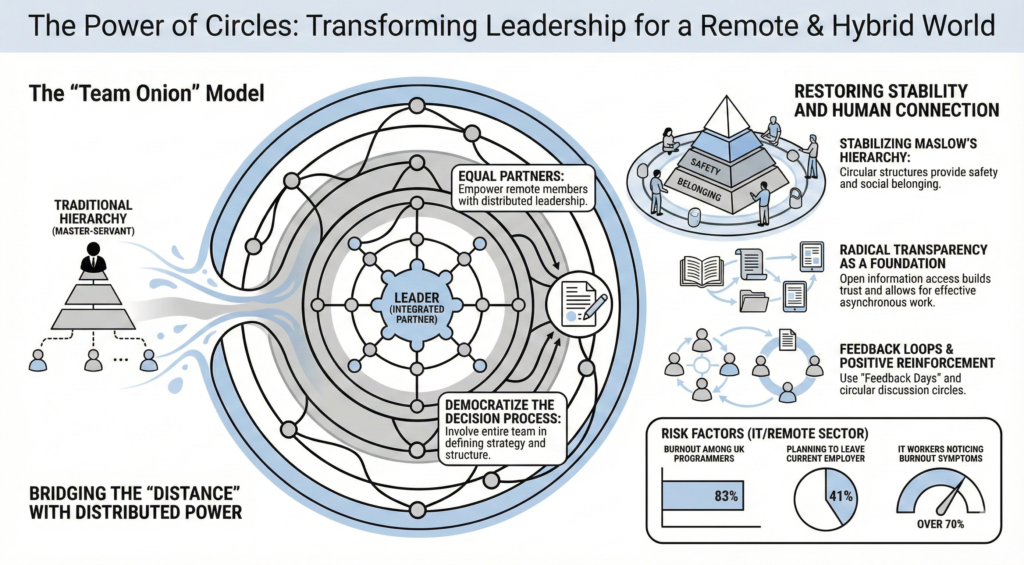
- Visualizing the Leader as Part of the Team: Traditional hierarchies isolate leaders. Changing the visualization of the team structure from a vertical hierarchy to a circular model—where the leader is embedded within the team—can psychologically reinforce collaboration and accessibility.
- Open Space Technology: To address hidden frustrations and leverage the team’s collective intelligence, leaders can use Open Space Technology. In this format, the team creates the agenda themselves, bringing up the topics that “hurt” or matter most to them, fostering open dialogue about real issues.
- Cultivating Gratitude: To counter negativity, leaders should actively implement Kudos or gratitude walls (using tools like Miro for remote teams) where team members can publicly appreciate one another. Additionally, organizing a Feedback Day focused specifically on positive reinforcement helps build morale.
- Understanding Diversity: Using personality profiling tools (like DISC or Gallup/CliftonStrengths) helps the team understand their differences in analytical or social styles. This transforms diversity from a buzzword into a practical asset for better communication and task allocation.
3. The “Human” Leader Mindset
Tools alone are insufficient without a shift in the leader’s attitude toward authenticity and psychological safety.
- “Get Off the Pedestal”: Leaders foster resilience by admitting when they don’t know the answer or have made a mistake. This vulnerability signals that it is safe for others to be imperfect.
- Permission to Fail: Creating a culture where there is explicit permission to make mistakes, followed by constructive analysis (retrospectives) rather than blame, allows the team to innovate without fear.
- Healthy Assertiveness and Self-Care: A leader must model self-care (“put your own mask on first”). This includes practicing healthy assertiveness regarding mental health—for instance, treating mental exhaustion as a legitimate medical issue requiring sick leave (L4), rather than trying to “fix” the employee personally.
By combining these strategic tools with a human-centric approach, leaders can move away from the pressure of being a “SuperHuman” and instead focus on building resilient, connected relationships that withstand instability.
Building a winning team for the AI era
Building a winning team for the AI era requires a fundamental shift in mindset from a “human-centric” approach to a multi-species partnership. We are transitioning into a world where humans are no longer the sole intelligent force, and survival depends on our ability to collaborate with AI as a new, distinct species.
Based on the “Lean & Evidence-Based Leadership” framework and my personal experience, here is how to build that team:
1. Shift from Hierarchy to Circular Structures
Traditional vertical hierarchies fail in the AI era because they block the flow of information and decision-making. AI agents naturally operate in circular feedback loops (e.g., Build-Measure-Learn).
- The “Team Onion” Model: You should structure your team using circular models (like the “Team Onion” or “Dragonfly” structures). This visualizes leaders as part of the team rather than above it, facilitating the integration of AI agents who act as peers or “super-geniuses” rather than subordinates.
- Decentralized Autonomous Organizations (DAOs): Circular structures align well with DAOs, where decision-making is distributed. This prepares the organization for teams composed of both humans and autonomous AI agents working in sync.
2. Treat AI as a Partner, Not a Servant
A critical error is viewing AI solely as a tool to be “ordered” around. The sources describe AI as a “super genius” that is faster, more efficient, and focused on goals.
- Abandon the “Order” Paradigm: Treating super-intelligent entities as servants (a “master-slave” dynamic) is dangerous and inefficient. If you block smarter individuals (or AI) with rigid commands, you limit the team’s potential. Instead, the relationship must be based on partnership and augmentation.
- Focus on Strengths: Assign AI tasks involving complex calculations, data analysis, and pattern recognition. Let humans focus on creativity, empathy, social intelligence, and ethical judgment.
3. Establish a “Common Protocol” of Communication
AI interprets commands literally and lacks emotional nuance, while humans often “play games,” hide intentions, or rely on implicit context. To build a winning team, you must bridge this communication gap.
- Radical Transparency: AI requires total transparency to function correctly. The team must move away from information silos and political maneuvering toward openness and honesty. In an AI world, concepts of privacy and boundaries will fundamentally change, so the team must be comfortable with constant information flow.
- Context over Instruction: Instead of giving specific instructions on how to do something, leaders must provide AI with the full context, intention, and desired outcome, allowing the AI to determine the most efficient path.
4. Unite Around a “North Star” (Vision and Values)
Because AI moves with high acceleration, a team without a strong anchor will quickly drift apart.
- Iterative Vision: A static mission statement is insufficient. You must validate the Shared Vision iteratively (e.g., monthly or quarterly) to ensure alignment between human goals and AI execution.
- Human-Centric Values: To prevent AI from viewing humans as obstacles to efficiency, the team must be grounded in utilitarian and humanistic values like kindness, openness, and safety. You must explicitly “show” AI these values to guide its learning and decision-making.
5. Leverage Lean as the Foundation
Lean methodologies are not just for software development; they are the training ground for the AI era.
- Circular Thinking: Agile trains the human brain to shift from linear to circular thinking (iterations, feedback loops), which mimics how AI “thinks” and learns.
- Empiricism: Evidence-based leadership relies on data and experiments rather than intuition alone. This aligns human leadership with AI’s data-driven nature, creating a common ground for decision-making.
6. The Human Role: Consciousness and Empathy
In a winning team where AI handles execution and optimization, the human role shifts to “Consciousness” and “Humanity” (empathy, love, biological connection).
- Diversity: You must diversify the team not just by gender or ethnicity, but by neurodiversity and background. A diverse team provides a broader set of data and perspectives for AI to learn from, preventing bias and fostering creativity.
- Psychological Safety: Leaders must “get off the pedestal,” admit mistakes, and show vulnerability. This builds the trust required for humans to feel safe working alongside powerful AI agents without falling into atavistic fear responses (fight, flight, freeze).
By combining these elements—circular structures, radical transparency, deep human values, and Agile processes—you build a “social capitalism” ecosystem where humans and AI coexist in symbiosis rather than competition.


