
AI Economy DEconstruction: Through Decentralisation to Liquidity
Economical
DEconstruction
Visualizing the paradigm shift from macroeconomic hierarchies to the Soloeconomy.
The Stakeholder Matrix
Status: Solid EconomySelect a Layer
The traditional economic model relies on four established pillars. Click on any row in the matrix to understand its historical role.
To observe the structural shift proposed by Beata Mosór, click “Inject AI Paradigm” at the top right.
The SoloEconomy – A Macroeconomic Impact of AI Economy Disruption
Author: Beata Mosór
Model: Gemini 3.1. Pro
1. Introduction
Contemporary macroeconomic theory rarely confronts a catalyst capable of fundamentally redefining market structures, labor dynamics, and the intrinsic nature of value creation. However, the exponential acceleration of Artificial Intelligence (AI) and decentralized cryptographic networks has initiated precisely such a systemic shift. The traditional, solid institutional and corporate frameworks of the twentieth century – characterized by rigid hierarchical structures, the pursuit of economies of scale, and centrally managed structures – are currently undergoing an erosion. The foundational premise of this transformation is articulated through my concept of the “SoloEconomy”, a model situated within the broader framework of the “Liquid Future” that I formulate.
This paradigm posits that artificial intelligence is not merely an auxiliary technological tool to be integrated into existing linear production processes. Rather, it operates as a fundamental, generative force that shifts the economic center of gravity from massive, centralized systems to the autonomous, hyper-efficient individual. In this increasingly liquid modernity introduced in the literature on the philosophical and social level profoundly by Zygmunt Bauman [Bauman, 2006], static economic maps based on predictable cyclical fluctuations and centralized structures are dissolving. The traditional barriers to market entry – such as access to deep capital pools, the necessity of large human workforces, and the requirement for extensive physical and administrative infrastructure – are collapsing under the weight of AI-driven decentralization. By drastically reducing information asymmetry and approaching zero marginal transaction costs, AI introduces a distinct “mini-economic” layer predicated on extreme individual economic freedom. This dynamic establishes the architectural foundation of the SoloEconomy.
If traditional models of economic growth relied heavily on the continuous accumulation of capital and the deployment of massive labor forces, the AI economy champions an entirely divergent model. In this new construct, the exponential efficiency of a single individual – the “solopreneur” – can rival or significantly exceed the output and valuation of entire corporate departments or legacy firms. In this paper I will estimate the macroeconomic impact of the SoloEconomy model by synthesizing demographic shifts documented by Eurostat, micro-enterprise dynamics tracked by the US Small Business Administration (SBA) and country specific statistic offices (a.i. Poland’s Statistics Poland – GUS), AI productivity data from Stanford University, and global wealth distribution metrics. The ensuing analysis demonstrates that the SoloEconomy is not a speculative theoretical abstraction, but a measurable, accelerating reality with profound implications for global fiscal policy, corporate governance, organizational design, and the future utility of human labor.
2. Theoretical framework and the architecture of the SoloEconomy
2.1 The Redefinition of Disruption and the drive toward Decentralization
Cambridge Dictionary stands that disruption is ‘the action of preventing something, especially a system, process, or event, from continuing as usual or as expected’ [Cambridge Dictionary, 2026]. Within public discourse, the term “disruption” is frequently conflated with chaotic destruction or the total annihilation of incumbent markets. The SoloEconomy model mandates a critical, semantic correction of this definition. Disruption, specifically within the context of the AI economy, must be understood as a rapid market correction mechanism rather than an inherently destructive force. As Joseph Schumpeter wrote:
‘The fundamental new impulse that sets and keeps the capitalist engine in motion comes from the new consumers’ goods, the new methods of production or transportation, the new markets, the new forms of industrial organization that capitalist enterprise creates… that incessantly revolutionizes the economic structure from within, incessantly destroying the old one, incessantly creating a new one. This process of Creative Destruction is the essential fact about capitalism.’ [Schumpeter, 1942]
Traditional theories of disruptive innovation, most notably those formulated by Clayton Christensen [Christensen, 1997], posited that smaller firms possessing fewer resources could successfully challenge established industry incumbents by initially offering simpler, more affordable, and highly accessible solutions [Christensen, Raynor i McDonald, 2015]. The SoloEconomy refines this theory to accurately reflect the realities of the artificial intelligence era. In this refined framework, disruptive innovation occurs when a smaller entity – often a single individual augmented by AI – successfully challenges established, massive systems, rather than merely competing with other traditional firms.
„Disruptive innovation occurs when a smaller entity possessing fewer resources successfully challenges established, massive systems, offering simpler, more affordable, and highly accessible solution”.
This deliberate semantic shift from “firm” to “entity” and from “business” to “system” yields one of the core hypotheses of the liquid economy: disruption leads to decentralization. Equipped with artificial intelligence, decentralized autonomous organization (DAO), distributed ledger technologies, an individual operator can actively challenge the legacy banking system via Decentralized Finance (DeFi), or challenge traditional media, coding, and education systems via proprietary or open-source Large Language Models (LLMs), Personal AI, or own Small Language Models (SMLs) [Belcak i in. 2025].
This structural shift signals a definitive transition from traditional “economies of scale” – where size dictates market power – to “economies of innovation,” where technological superiority, speed, and intellectual agility outweigh corporate mass.
A tangible manifestation of this shift is observable within the highly rigid United States defense sector, where federal contracts are increasingly diverted from massive legacy systems like Lockheed Martin and Boeing toward smaller, radically Agile, AI-integrated entities such as Anduril and Palantir, proving that even the most monopolistic sectors are susceptible to AI-driven decentralization.
2.2 The Five-Pillar Macroeconomic Architecture
Classical macroeconomic models have traditionally recognized four primary shareholders or actors operating within the economy: Households, Businesses, Governments, and States. My SoloEconomy model introduces a critical, highly disruptive fifth pillar: The Individual. This architectural revision fundamentally acknowledges the detachment of the individual from the traditional household unit or the corporate structure, recognizing the solo operator as a fully independent vector of massive value creation.
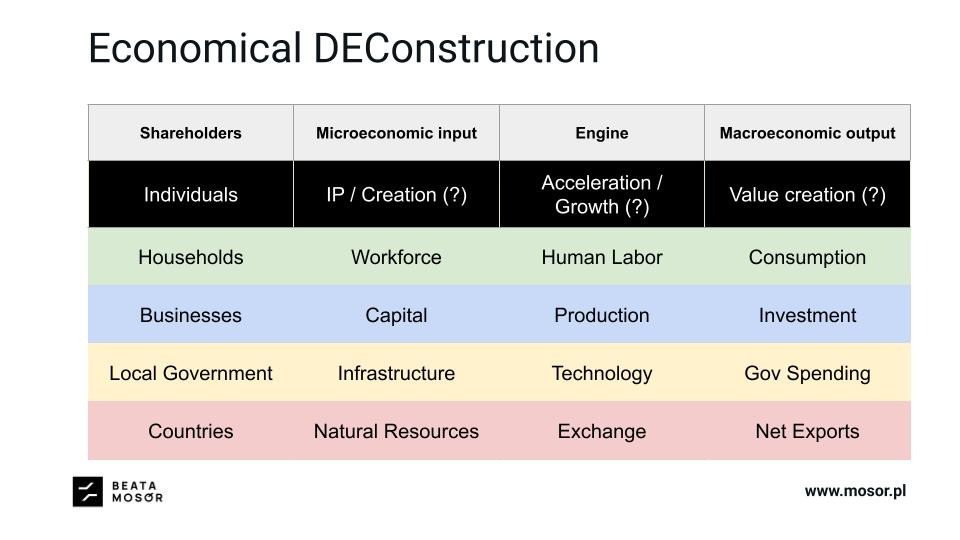
Illustration: The SoloEconomy Concept by Beata Mosór®.
The defining feature of this new macroeconomic pillar is the deeply ambiguous nature of its primary input: Intellectual Property (IP) and creation. The legal, regulatory, and economic status of intellectual property generated via the continuous collaboration between humans and artificial intelligence remains the most significant unresolved variable in contemporary economics. Through the process of extreme individualization, the solo operator assumes complex roles that were traditionally strictly reserved for heavily centralized and capitalized institutions.
The solopreneur acts as a Money Creator by leveraging Decentralized Finance (DeFi) protocols, tokenization mechanisms, and cryptocurrency ecosystems (a.i. by utilizing Proof-of-Work protocols or by becoming a miner) to bypass central banking infrastructure. They function as an Energy Generator by utilizing decentralized renewable energy sources, microgrids, and electric vehicle battery storage to attain energy sovereignty [Reuter, Loock i Cousse 2019].
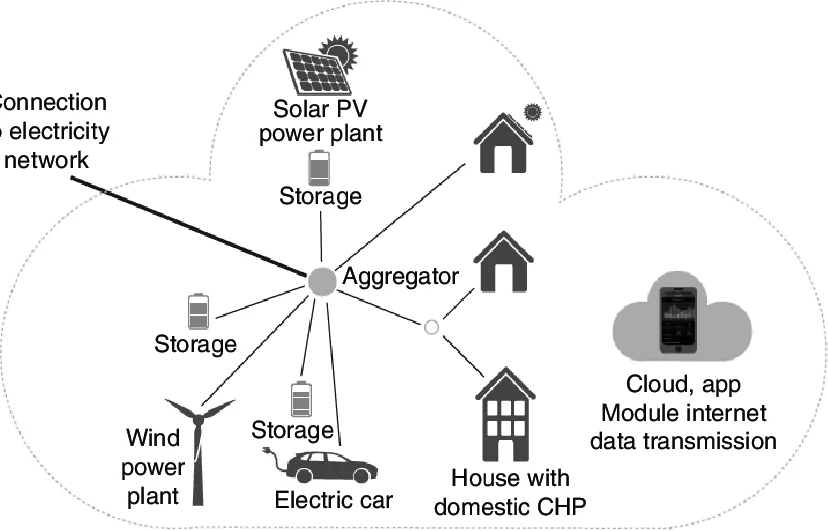
Illustration: [Reuter, Loock i Cousse 2019]
Furthermore, they operate as an Organization Creator by structuring and deploying Decentralized Autonomous Organizations (DAOs) and autonomous AI agents to execute complex multi-step workflows. Finally, they act as a Model Creator by developing, fine-tuning, and owning Personal Intelligence models via open-source Small Language Models (SLMs) [Belcak i in. 2025]. In this new paradigm, human cognitive input serves strictly as the initial catalyst, while artificial intelligence functions as the exponential engine, permanently decoupling economic productivity from traditional human labor hours.
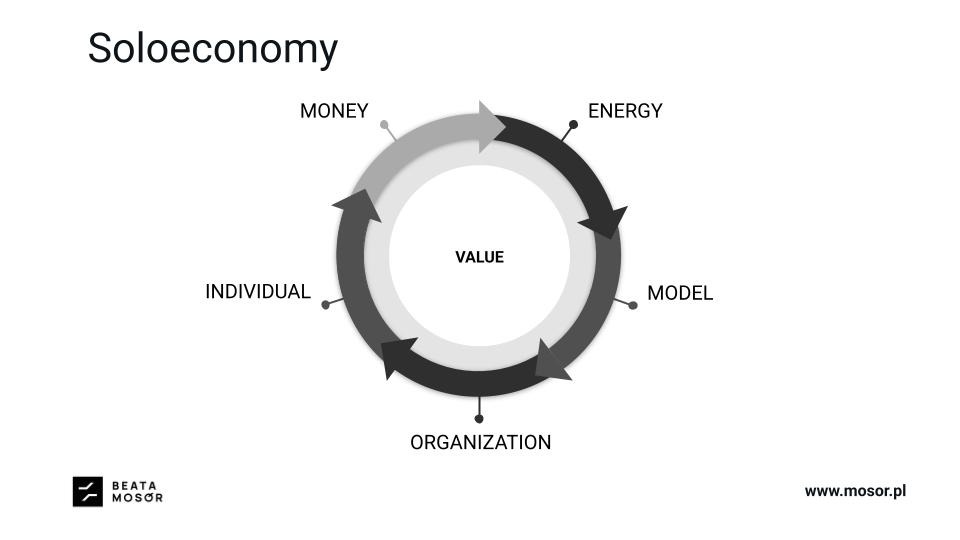
Illustration: The SoloEconomy Concept by Beata Mosór ®.
3. Demographic Foundations: The atomization of society and consumption
The long-term viability and the rapid acceleration of the SoloEconomy are deeply intertwined with structural demographic shifts moving aggressively towards individualization. Macroeconomic decentralization is preceded, mirrored, and facilitated by social decentralization, specifically the systemic dismantling of traditional family and household structures across advanced western economies.
3.1 The unprecedented rise of the single-person Household
Granular demographic data provided by the European Union’s statistical office, Eurostat, illustrates a profound, irreversible structural shift in household composition. In 2025, the European Union housed approximately 203.1 million distinct households. The overwhelmingly dominant and fastest-growing demographic within this vast cohort is the single-person household [Eurostat, 2025a].
Single-person households account for 76.1 million units, representing nearly one-third of all households across the entire European Union [Eurostat, 2025a]. This specific demographic has experienced a massive 19,2% growth trajectory between 2016 and 2025, a trend driven by the individualization of life courses, shifting patterns in family formation, and the broader aging of European societies. Concurrently, the marriage rate across the European continent has steadily and continuously declined to approximately 4.5 to 5.0 marriages per 1,000 inhabitants [Eurostat 2025a].
| Household Type | Number in UE (Millions) |
|---|---|
| Single adult without children | 76,1 |
| Couples without children | 48,9 |
| Other household types without children | 30,7 |
| Couples with children | 29,9 |
Source: [Eurostat, 2025a]
This systemic societal atomization is a macroeconomic signal. The single-person household represents a highly autonomous, deeply insulated unit of consumption and, increasingly within the context of the AI revolution, a unit of production. As individuals separate from traditional collective units, their reliance on decentralized digital networks for income, social interaction, and commerce increases exponentially.
3.2 Consumption expenditure, inflationary pressures, and the cost of living
The economic behavior and financial constraints of single-person households shape the architecture of the liquid economy. An analysis of Eurostat’s Household Budget Survey (HBS) data reveals that a staggering 61% of household consumption expenditure in the EU is strictly and inflexibly allocated to essential survival vectors: housing, water, electricity, gas, food, and basic transportation.
Severe global inflationary pressures have placed intense pressure on single-income households. In Spain, for instance, housing prices surged driven by market speculation and limited public housing, triggering massive civic protests. In Greece, comprehensive survey data indicates that 62.1% of households report that their income runs out completely before the end of the month, a condition that is highly prevalent among single-person households where the immense financial burden cannot be distributed across multiple adult earners. In these scenarios, available income suffices for an average of only 18 days per month.
This excessively high baseline cost of living for autonomous individuals acts as a powerful, unavoidable catalyst for the SoloEconomy. Traditional, linear wage labor – where an individual trades a fixed hour of time for a fixed amount of fiat currency – increasingly fails to provide sufficient economic mobility or baseline survival capability for single-income households against skyrocketing housing and utility costs. Consequently, individuals are heavily, systemically incentivized to abandon traditional employment and seek new income streams through solopreneurship, digital production, and AI automation, utilizing technology to maximize output without concurrently increasing personal labor hours.
4. The Micro-Enterprise Boom: The Anatomy of the Solopreneur
The social individualization observed in demographic data is mirrored by a ongoing restructuring of the global business landscape. The twentieth-century era of the sprawling industrial conglomerate serving as the primary employer is rapidly giving way to a decentralized network of micro-enterprises and nonemployer firms.
The thesis of a radical productivity divergence is confirmed by both macroeconomic estimates and studies on labor organization. The OECD documents the growing adoption of AI in enterprises and its impact on productivity [OECD 2025b]. Recent literature even introduces the concept of ‘digital co-founders’: AI agents that perform the functions of entire teams within a solo venture [Digital Co-Founders, 2025].
4.1 Nonemployer statistics and the United States Small Business Landscape
The United States exemplifies the rapid transition toward individual economic autonomy. According to the US Small Business Administration (SBA), as of 2025, there are 36.2 million small businesses operating within the United States, constituting 99.9% of all commercial entities. These small businesses employ 62.3 million Americans, accounting for 45.9% of the entire private sector workforce, and are responsible for generating 43.5% of the gross domestic product (GDP) [U.S. Small Business Administration, Office of Advocacy, 2025].
Crucially for the thesis of the SoloEconomy, the vast majority of these entities are entirely devoid of employees. Of the 36.2 million small businesses in the US, 29.8 million – or 82.3% of the total – are officially classified as “nonemployer firms,” meaning they are businesses operated by a single individual with absolutely no paid employees [U.S. Census Bureau, 2024].
The total economic footprint of the solo operator in the United States is staggering. In 2023, nonemployer establishments generated nearly $1.8 trillion in total combined revenue, representing approximately 6.4% of the US GDP. The sheer volume of these highly agile, single-person entities has nearly doubled over the past few decades, rising from 15.4 million in 1997 to 29.8 million.
Despite their size, these small firms punch far above their weight in global trade, representing 97.2% of all identified exporting firms in the US and accounting for $588.4 billion in export value.
This structural shift clearly indicates that the traditional friction associated with starting, managing, and operating a business has fallen. Artificial intelligence and cloud-based infrastructure allow individuals to independently manage marketing, logistics, accounting, and administration – tasks that previously required dedicated, salaried personnel. This technological leverage renders the zero-employee business model highly lucrative, resilient, and globally scalable.
4.2 The Polish Micro-Enterprise Engine (JDG) and Regulatory Friction
This change is highly visible in the European market, particularly in Poland. According to data from Statistics Poland (GUS), in the third quarter of 2025, there were 2,875,994 active enterprises in Poland. Micro units (i.e. with up to 9 employees) constituted 95.9% of the entire group of active enterprises, and compared to the 3rd quarter of 2024, YtY their number increased by 5.2% [GUS, 2025].
The Polish economy is structurally, fundamentally dependent on the “Jednoosobowa Działalność Gospodarcza” (JDG), or solopreneurship. Approximately 77.5% of all micro-firms in Poland are single-person entities. These micro-enterprises are not marginal or peripheral players; they actively generate 42.6% of all jobs within the enterprise sector [PARP, 2025].
Despite operating within a highly volatile, complex regulatory and tax environment, the volume of active micro-enterprises in Poland grew by 30.8% over the decade spanning 2014 to 2024. The dynamism of this sector is immense; in 2025 alone, the central registry (CEIDG) processed 288,800 applications for the establishment of new JDGs [PARP, 2025].
However, operating a solo business model carries extreme risk and high mortality rates. The survival rate for the 2023 cohort of new Polish enterprises into their first full year of operation was a mere 59.2%, with survival varying heavily by sector (e.g., professional and scientific activities showed higher resilience at 72.2%, while hospitality and culture struggled significantly). Extremely high fixed operational costs, most notably the mandatory social security contributions (ZUS) – which for a standard entrepreneur in 2026 total roughly 1,693 PLN monthly entirely exclusive of dynamic, revenue-based health contributions—place immense, often fatal pressure on linear, time-based business models [PARP, 2025].
This regulatory and financial friction is precisely where the SoloEconomy intersects with Artificial Intelligence. The high mortality rate of traditional micro-enterprises is largely a direct function of administrative overload, compliance costs, and the hard physical limits of human labor capacity. By aggressively integrating AI, the modern solopreneur transcends these biological and administrative limitations, entirely automating the bureaucratic overhead that traditionally suffocates small, undercapitalized enterprises.
5. The Redefinition of Value: New Currencies in the Liquid Economy
In a liquid economy where artificial intelligence effectively marginalizes the cost of traditional cognitive labor and software production, the fundamental definition of macroeconomic “value” must necessarily evolve. The SoloEconomy posits that currency and value will permanently detach from physical commodities (such as the Gold Standard or petrodollars) and pivot entirely toward intangible, uniquely human, and pure computational assets.
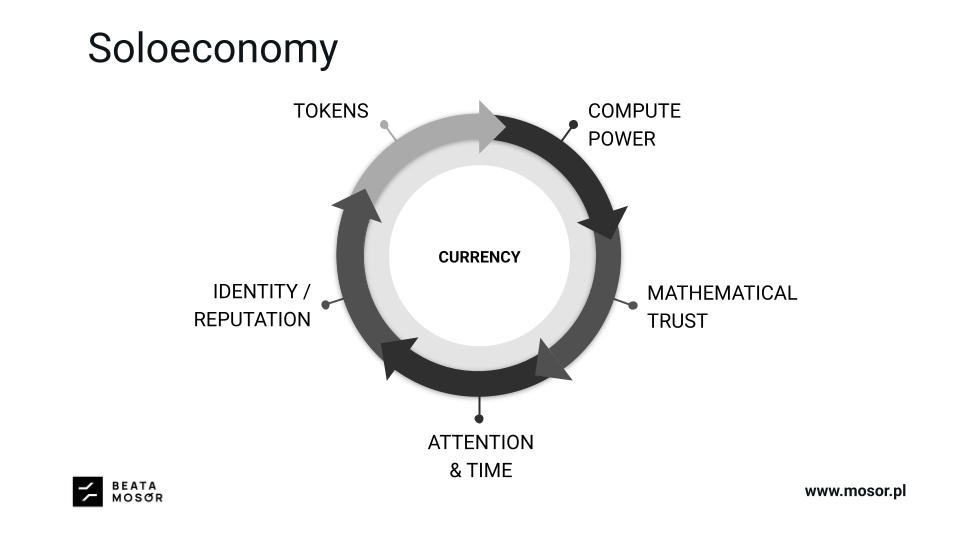
Illustration: The SoloEconomy Concept by Beata Mosór ®.
A closer look at the Soloeconomy reveals a foundation for redefining value in the AI era. It challenges current monetary policies and paves the way for entirely new currencies. This leads us to the core assumption of the model:
„In the Soloeconomy model, the individuals create value by investing attention and time into building their identity and reputation (e.g., intellectual property creation). This validated identity generates tokens, which are then used to purchase compute power (energy) to scale their operations, ultimately securing and validating the entire cycle through mathematical trust.”
This translates into possible future currencies:
5.1. Attention and Time
In the “Economy of Attention,” human focus is the ultimate scarce resource. As the seminal Google paper “Attention is all you need” [Vaswani, 2017] suggested, human attention is a foundational input for AI systems. In this paradigm, the time and focus we dedicate to interacting with AI become a quantifiable and tradable asset.
• Attention as Value: Because AI systems require human interaction and supervision to function or improve, the time and focus humans dedicate to these systems become quantifiable assets.
• Quantifiable Interaction: Future value exchange might be based on a “quant of time” or the specific energy invested in human-AI interaction.
5.2. Identity (ID) and Reputation
Currency is becoming linked to personal identity. Projects like WorldCoin, which quantifies identity by scanning a user’s retina, are early experiments in this domain. This trend extends to personal brand tokens like Trump Coin, where individuals can become the issuers of their own currency, their value backed by their reputation and skills. This signifies a fundamental shift where value is backed not by a physical resource, but by the reputation, skill, and verifiable identity of an individual.
• Proof of Personhood: This concept is exemplified by projects like WorldCoin, which attempt to quantify human identity through biometric data (such as retina scans) to distinguish humans from AI agents.
• Personal Tokens: In the emerging “SoloEconomy,” individuals (solopreneurs) may become issuers of their own “personal brand coins.” In this model, currency is backed by an individual’s skills, reputation, and verifiable identity rather than a central bank or natural resources.
5.3. Tokens (Programmable Value)
In the Soloeconomy, the abstraction of value could be also captured and transferred through Tokens. Unlike FIAT money, which represents generalized debt, tokens are units of data, which NVidia describes as programmable fundamental building blocks that large language models (LLMs) use to process and generate data.
In this model, data is viewed as the “fuel” for AI, making it a potential form of currency.
• Data as Asset: In this model, value is derived from the quality, relevance, and ethical sourcing of data provided to AI systems.
• Byte of Data: A potential unit of exchange could be a “byte of data,” reflecting its necessity for training and maintaining AI models.
5.4. Energy and Compute Power
Another hypothesis of mine states that the currency of the future will be backed by the physical resources required to power AI. Value is also being redefined by the physical requirements of AI itself. Just as the U.S. dollar has been linked to oil, the currencies of the future may be intrinsically tied to the electrical energy and computing power (GPU/CPU) that AI requires to function.
Bitcoin’s energy model is a clear precursor to this trend of turning energy through compute power into mathematical trust [Nakamoto, 2008].
• Compute Power: Just as the US dollar was historically linked to gold or oil, the “AI currency” could correspond to computing power (GPU/CPU) and electrical energy.
• Decentralized Emission: This mirrors the Bitcoin model, where currency creation is tied to the cost of energy and hardware availability, effectively decentralizing the “emission” of money by tokens creation or through the mining process.
5.5. Mathematical Trust
In this theory I consider a return to the original function of money as a mechanism for social trust that is turn into the mathematical / algorithmic trust facilitated by technology.
• Consensus-Based Value: Value may be derived from the collective agreement of a community, as seen in decentralized autonomous organizations (DAOs) and ecosystems like Ethereum, where users co-determine utility and value.
• Intelectual Value into Mathematical Trust: The cryptocurrency environment transfer the Intelectual Property value into the currency (a.i. Bitcoin) through Proof-of-Work, Zero-Knowledge Proofs consensus.
6. Macroeconomic Impact and Strategic Policy Implications
The rapid transition to the SoloEconomy – driven by the demographic atomization, AI acceleration, and borderless decentralized infrastructure – carries disruptive macroeconomic consequences that governments and institutions are currently trying to manage.
6.1 Macroeconomic Impact
Currently, nonemployer firms (solo operators) generate approximately 6.4% of the US GDP, totaling nearly $1.8 trillion. However, this figure represents the pre-AI ceiling of human capacity, where solo operators were bottlenecked by the biological limits of time and administrative friction.
If the 29.8 million nonemployer firms in the US adopt AI agentic technology, their capacity to service enterprise-level contracts previously awarded to mid-sized B2B firms will increase greatly. It is analytically highly probable that the GDP contribution of the SoloEconomy (individuals and micro-entities) will expand within the next years, systematically cannibalizing the market share of middle size companies and in some cases corporations. The growth of the EMILLI wealth class confirms that surplus value is being aggressively captured by agile individuals rather than being distributed via wages within traditional corporate structures.
Policy Implication: Policies need to be redefined leveraging the possibility of creation of the autonomous agentic organizations, defining law responsibility of founders and owners, as well as profit sharing in such cases.
6.2 Fiscal Policy Reform and the Taxation of Intellectual Property
The current fiscal framework across advanced economies relies heavily on taxing human labor (e.g., progressive income tax, payroll taxes, social security contributions). As AI systematically automates routine administrative, clerical, and middle-management roles, the traditional human labor tax base will need to be revisioned. The new value creation circle is rapidly consolidating in the hands of hyper-productive solopreneurs whose primary output is Intellectual Property (IP).
Policy Implication: Sovereign states must implement structural fiscal reforms that shift the primary tax burden away from human labor – which is increasingly becoming an economically vulnerable good. And redirect it toward the promotion of creation of Intellectual Property, as well as decreasing the cost of consumption of energy and compute resources to enable acceleration.
6.3 Labor Market restructuring and the redefinition of the Micro-Entrepreneur
The AI-driven productivity paradox dictates that while low-to-mid-level cognitive tasks are automated, the specific individuals who learn to strategically command and orchestrate AI models (the “AI Leaders”) will capture outsized economic returns. The traditional Small and Medium Enterprise (SME) model, which relies on building a hierarchy of human employees, will increasingly struggle to compete on price or speed with a single solo operators deploying autonomous AI agentic systems.
Policy Implication: Economic policy should redefine the “micro-entrepreneur” not merely as a self-employed freelancer operating on the margins, but as a primary, highly scalable economic actor central to national growth. This requires easing the severe regulatory friction and bureaucratic overhead that currently penalize single-person entities and stifle innovation. Furthermore, national education systems must drastically pivot away from training hyperspecialized workers destined for corporate hierarchies, and focus instead on empowering systemic thinkers capable of orchestrating AI ecosystems.
7. Conclusion
The SoloEconomy model presents a diagnosis of the future macroeconomic landscape. Far from being a speculative, academic theory, the Liquid Future & Soloeconomy concepts are visibly and aggressively manifesting across multiple, distinct statistical domains.
The severe demographic fracturing of the traditional household unit and the resulting cost-of-living pressures, the massive proliferation of nonemployer firms already generating trillions in revenue, the exponential productivity gains and administrative overhead decimation facilitated by massive AI deployment, and the growth of highly liquid, decentralized, autonomous protocols all point conclusively to a singular economic reality: the primary, dominant economic unit of the 21st century is the technologically augmented, sovereign individual.
Disruption within this specific context is not the chaotic destruction of economic value, but a radical, highly efficient decentralization of power, transferring agency, capital, and leverage from the incumbent corporate monolith directly to the agile solopreneur – AI or human. As the fundamental nature of value shifts away from physical capital and natural resources toward time, attention, identity, and algorithmic computational output (mathematical trust), the survival of national economies will depend entirely on their structural ability to adapt to this extreme deconstruction into fluidity.
Nations and institutions that aggressively restructure their fiscal policies, embrace decentralized governance frameworks, and empower the individual creator will command the immense wealth of the AI economy. Conversely, those that attempt to cling to the rigid, hierarchical, labor-intensive paradigms of the 20th century will find themselves structurally obsolete and financially starved in the liquid future.
Bibliografia
- Bauman Z. [2006]. Płynna nowoczesność, tłum. T. Kunz. Kraków: Wydawnictwo Literackie.
- Belcak P., Heinrich G., Fu Y. i in. [2025]. Small Language Models Are the Future of Agentic AI. NVIDIA Research, arXiv:2506.02153.
- Cambridge Dictionary [2026]. Hasło: disruption. Cambridge: Cambridge University Press [dostęp: 2026].
- Christensen C.M. [1997]. The Innovator’s Dilemma: When New Technologies Cause Great Firms to Fail. Boston: Harvard Business Review Press.
- Christensen C.M., Raynor M.E., McDonald R. [2015]. What Is Disruptive Innovation? „Harvard Business Review”, vol. 93, nr 12, s. 44–53.
- Eurostat [2025a]. Household composition statistics. Luxembourg: Statistics Explained, https://ec.europa.eu/eurostat/statistics-explained/index.php?title=Household_composition_statistics [28.05.2026 r.].
- Eurostat [2025b]. Marriage and divorce statistics. Luxembourg: Statistics Explained, https://ec.europa.eu/eurostat/statistics-explained/index.php?title=Marriage_and_divorce_statistics [28.05.2026 r.].
- Mosór B., The Liquid Future of AI Economy, https://mosor.pl/technology/the-liquid-future-ai-economy/ [dostęp: 28.05.2026 r.].
- Mosór B., ‘Agile Transformation’ by Neil Perkin: Is Agile the Future of AI?, https://mosor.pl/books/is-agile-the-future-of-ai-agile-transformation [dostęp: 28.05.2026 r.].
- Mosór B., Ekonomia w erze sztucznej inteligencji: narzędzia, modele i transformacja gospodarcza. Wystąpienie podczas webinarium organizowango przez PTE w dniu 07.10.2025 r., https://www.youtube.com/watch?v=8IY4jXFFh0w&t=3560s [dostęp: 28.05.2026 r.],
- Mosór B., www.circmodel.com [dostęp: 28.05.2026 r.]
- Nakamoto S. [2008]. Bitcoin: A Peer-to-Peer Electronic Cash System.
- Polska Agencja Rozwoju Przedsiębiorczości [2025]. Raport o stanie sektora małych i średnich przedsiębiorstw w Polsce 2025. Warszawa: PARP.
- OECD [2023]. OECD Employment Outlook 2023: Artificial Intelligence and the Labour Market. Paris: OECD Publishing.
- OECD [2025a]. OECD Employment Outlook 2025: Can We Get Through the Demographic Crunch? Paris: OECD Publishing.
- OECD [2025b]. The Adoption of Artificial Intelligence in Firms. Paris: OECD Publishing.
- Reuter E., Loock M., Cousse J. [2019]. Digital Business Models for Local and Micro Power Markets. (w:) Micro and Local Power Markets, s. 193–221.
- Schumpeter J.A. [1942]. Capitalism, Socialism, and Democracy. s 82-84.
- U.S. Census Bureau [2024]. Nonemployer Statistics. Washington: U.S. Department of Commerce.
- U.S. Small Business Administration, Office of Advocacy [2025]. Small Business Profiles / Frequently Asked Questions About Small Business. Washington.
- UBS [2025]. Global Wealth Report 2025. Zurich: UBS Group AG.
- Vaswani A. i in. [2017]. Attention Is All You Need. (w:) Advances in Neural Information Processing Systems 30 (NIPS 2017).
- Williamson O.E. [1985]. The Economic Institutions of Capitalism. New York: Free Press.


