
The Liquid Future: Is AI Economy the Soloeconomy?
Please take a look at the newest version of my research here:
And now you can read the archive materials:
Soloeconomy
in the Age of AI.
A liquid future following grand economic disruption. Shifting the economic center of gravity from massive systems to the autonomous individual.
Beata Mosór
Tech Strategist & Researcher, CIRCmodel.com
New Paradigm: Liquid Future
Modern economic theory rarely faces a challenge so fundamental that it forces a complete redefinition of market structure. The traditional, “solid” institutional and corporate frameworks of the 20th century are undergoing rapid erosion under the influence of technological acceleration.
AI is not merely a tool; it is a paradigm shift that disrupts existing macroeconomic processes, adding a “minieconomic” layer based on individual economic freedom. The micro-entrepreneur becomes a key economic actor.
Solid Economy
Hierarchical structures, centralized control, macro-processes.
AI Disruption
Cognitive automation, erosion of traditional employment.
Soloeconomy
Autonomous scaling via AI agents. The One-Person Unicorn.
The disruption of the current economic system
I believe we are experiencing a strong decentralization of the job market, alongside a significant distribution of capital (socially and geographically). Data shows a growing number of small companies that are very efficient. The era of solopreneurs and creators is here.
Illustrations: The SoloEconomy Concept by Beata Mosór ®.
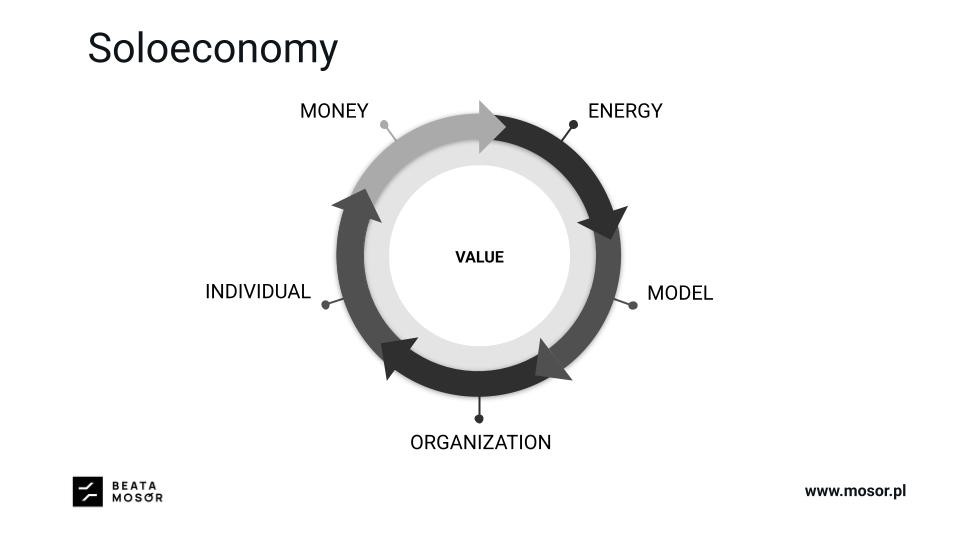
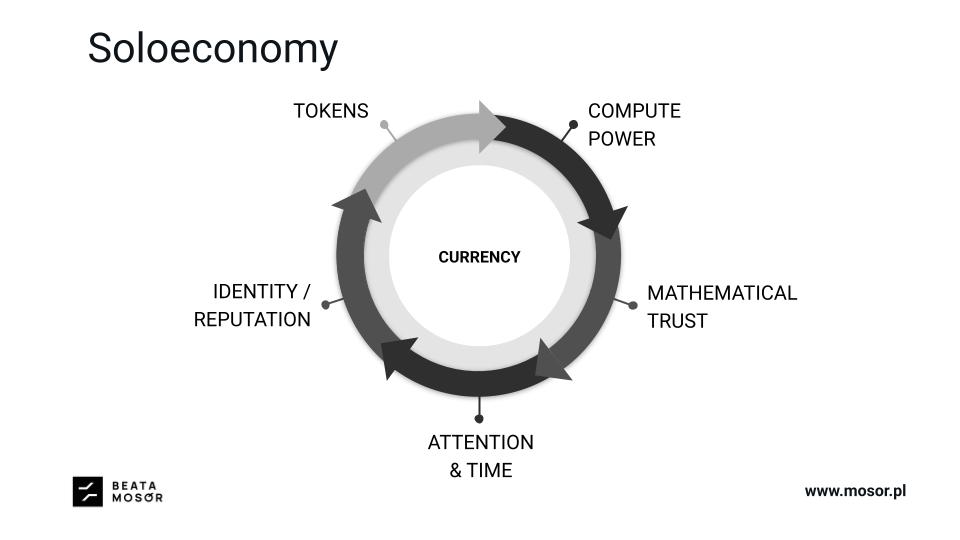
At the same time, with the growing number of currencies (including digital coins, stablecoins, and cryptocurrencies), we have reached a peak, and consolidation is coming. That will bring inevitable changes in monetary policies. Maybe we as a society are finally ready for the Ford concept of “money as energy.” And Bitcoin is energy.
What if I told you that in the Soloeconomy, we will face not only the decentralization of the job market, but also the energy market (everyone generating their own energy), the AI market (everyone having their own AI model – probably an SLM), and perhaps in the future, everyone having their own currency based on energy (based on Bitcoin?) or quantum technology. Soloeconomy is a step toward further decentralization and autonomy in the upcoming monetary and financial policy changes.
AI is disrupting the current economic model and giving back power to individuals. It changes monetary policy, giving people more financial freedom, and first and foremost, the economic impact it will make is significant.
Economical
DEconstruction
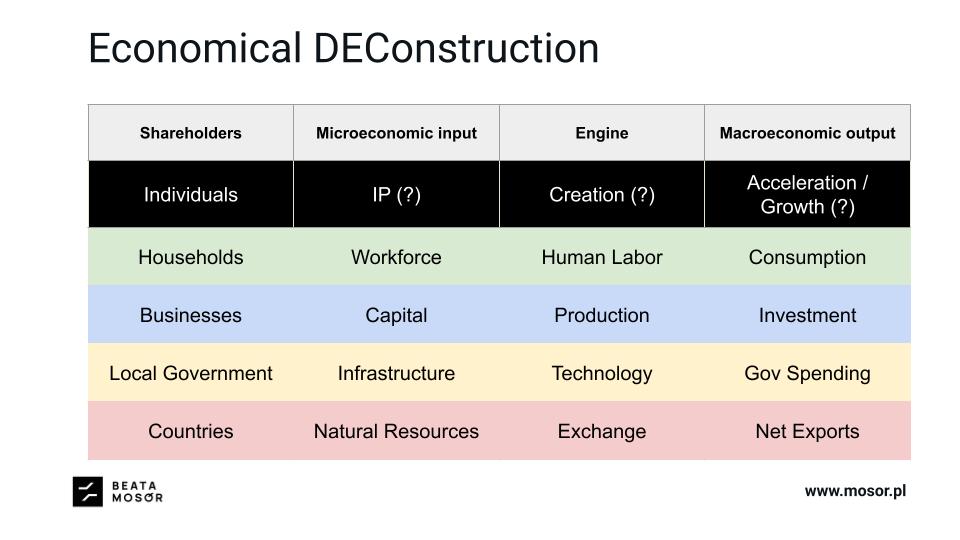
Visualizing the paradigm shift from macroeconomic hierarchies to the Soloeconomy.
The Stakeholder Matrix
Status: Solid EconomySelect a Layer
The traditional economic model relies on four established pillars. Click on any row in the matrix to understand its historical role.
To observe the structural shift proposed by Beata Mosór, click “Inject AI Paradigm” at the top right.
I called my theory Soloeconomy, and it’s the disruptive innovation that changes the current economic system adding the entire new layer to it.
Here are the crucial thoughts & hypothesis that I have:
💪 what we encounter is the disruptive innovation that is touching broader economical system, adding the entire new layer to the economy
💪 the disruption touches the current economy on many levels – from decentralizing households, capital, investment system, etc. as well changing the dynamics between business, government, and even countries through new global decentralised exchanges and new monetary policies
💪 the decentralisation on the technology level creates the opportunity to the economical system growth / acceleration through new creations, but also through the indivudualization of the models (popularisation of the SLMs) and decentralisation of the energy market (AC/DC chargers, energy independence from the system, etc.)
💪 the disruption touching the monetary policies creates the need for new currencies that will bring back the connection between real value and money – what we can observe are the connections between energy and money (Bitcoin), but also identity and money (Worldcoin)
The Future is Liquid
The future is liquid. This is not a metaphor; it is a diagnosis of our reality. The solid, predictable structures of the 20th-century economy, society, and business are dissolving under the immense, transformative pressure of Artificial Intelligence. AI is not merely another technology to be integrated into existing models. It is a fundamental, generative force reshaping our world at a civilizational level, giving birth to a new paradigm: the AI Economy. We stand at the precipice of a profound transition, one that demands we abandon the maps of the old world and learn to navigate a dynamic, fluid, and intelligent new reality.
Part I: The Great Dissolution – Deconstructing the Old World
Before we can architect the future, we must first understand the powerful currents dismantling the present. This requires a clear-eyed deconstruction of the core pillars of the old economy and an honest analysis of the fundamental tensions introduced by AI. These forces are not merely disrupting markets; they are challenging our very perception of reality, value, and control, forcing us to confront the obsolescence of our most trusted systems.
The primary tensions emerging between the fluid nature of our new reality and the deterministic power of AI are reordering our world. These are not simple technological challenges but deep, philosophical conflicts with profound business implications:
- Truth vs. Falsehood: The proliferation of AI-driven disinformation and deep fakes is eroding the very concept of objective truth. For businesses, this compromises everything from brand integrity to market intelligence, creating a landscape where authenticity is both paramount and perpetually under assault.
- Reality vs. Simulation: AI is blurring the lines between the physical and the digital, the real and the simulated. This shift impacts every facet of commerce, from product design and virtual prototyping to the fundamental nature of the customer experience, which can now be curated in hyper-realistic simulated environments.
- Intellectual Property vs. Open Generation: Traditional models of ownership and intellectual property are fundamentally challenged by the generative nature of AI, which learns from and remixes the entirety of human creation. This creates a critical conflict between established legal frameworks and the open, collaborative essence of AI-driven innovation.
- Human vs. AI: This is the ultimate tension. We have, for the first time, created a non-biological intelligence that may surpass our own. This forces us to question the role and centrality of humanity in an age of superintelligence, moving from a position of undisputed dominion to one of potential partnership or even subordination.
At the heart of this great dissolution is the principle of centralization. For centuries, we have built our systems—from finance and governance to energy and manufacturing—around central points of control. In the liquid future, these centralized structures are becoming dangerously fragile and obsolete. The primary driver of the new economy is a radical and irreversible shift towards decentralization, rendering the old command-and-control models powerless. This deconstruction is not an ending but a necessary clearing of the ground for what comes next.
Check my talk on AI Economy during “Economics in the Age of Artificial Intelligence: Tools, Models, and Economic Transformation,” seminar hosted by the Polish Economic Society >>
Part II: The New Genesis – Principles of the AI Economy
From the dissolution of the old world, a new economic genesis is emerging. This is not a simple evolution but a radical reimagining of how value is created, distributed, and defined. This new economy is built upon the foundational principles of decentralization, which unleashes unprecedented productivity, and a redefinition of value itself, moving beyond tangible assets to concepts as abstract as identity and attention.
The Core Principle: Decentralization Increases Liquidity
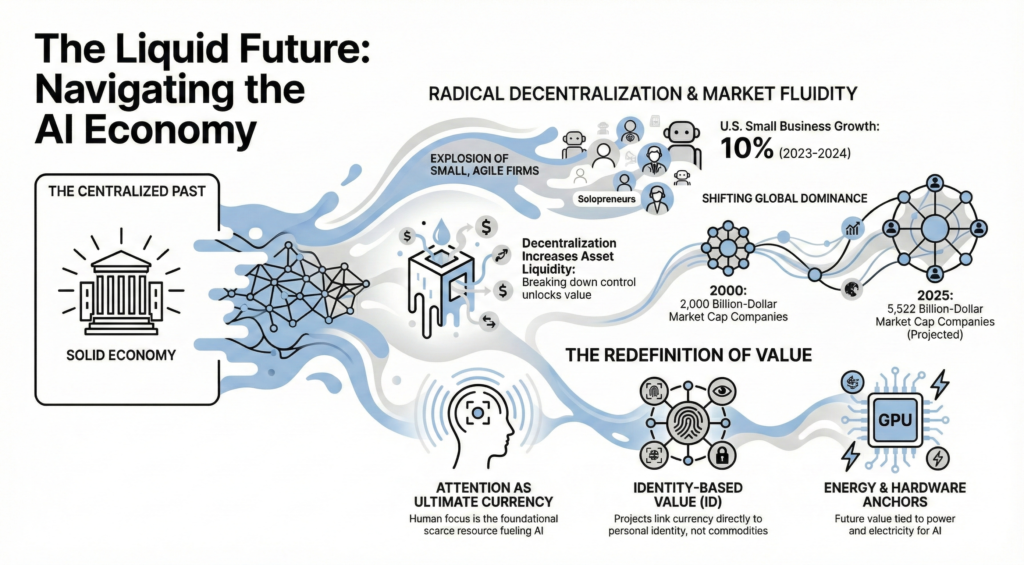
The central thesis of the AI Economy is that decentralization increases productivity and tradability, which in turn unlocks liquidity. By breaking down centralized structures, we unlock value and enable a more dynamic, efficient, and resilient economic system. This principle is manifesting across every critical sector:
- Decentralization of Markets: We are witnessing a systemic shift away from concentrated market power. The number of billion-dollar companies worldwide is projected to grow from 2,000 in the year 2000 to over 5,522 by 2025, with regions like Asia rapidly diminishing the historical dominance of the U.S. In parallel, the number of small, agile firms is exploding; the U.S. saw an approximate 10% increase in small firms between 2023-2024, and the EU counted 32 million active enterprises in 2022. This decentralization extends to financial, labor, and even energy markets.
- Decentralization of Production: The “SoloEconomy” is rising—an economy of hyper-efficient “solopreneurs” and small, autonomous organizations (DAOs, agentic organizations). These entities leverage AI to achieve massive productivity with minimal overhead, contracting work and managing complex operations without the need for traditional corporate structures or employees.
- Decentralization of Money: The very creation of money is being decentralized. Bitcoin serves as the primary example, operating with a variable number of issuers (miners) and a creation cost directly tied to physical resources like electrical energy and computing hardware. This breaks the monopoly of central banks and links currency creation to tangible, verifiable inputs.
The Redefinition of Value and Currency
www.mosor.pl
The Redefinition of Value:
New Currencies in the Liquid Economy.
“In the Soloeconomy model, the individual creates value by investing attention and time into building their identity and reputation (e.g., intellectual property creation). This validated identity generates tokens, which are then used to purchase compute power (energy) to scale their operations, ultimately securing and validating the entire cycle through mathematical trust.”
Attention and Time
The emergence of AI forces us to ask fundamental questions: What is value for AI? And what will be the currency of the AI Economy? The answers point towards a future where value is detached from traditional commodities and linked to new, often intangible, assets.
- Value as Identity: Currency is becoming intrinsically linked to personal identity. Projects like WorldCoin, which quantifies identity by scanning a user’s retina, are early experiments in this domain. This trend extends to personal brand tokens, where individuals—”solopreneurs”—can become the issuers of their own currency, their value backed by their reputation and skills. This signifies a fundamental shift where value is backed not by a physical resource, but by the reputation, skill, and verifiable identity of an individual.
- Value as Attention & Time: In the “Economy of Attention,” human focus is the ultimate scarce resource. As the seminal Google paper “Attention is all you need” suggested, human attention is a foundational input for AI systems. In this paradigm, the time and focus we dedicate to interacting with AI becomes a quantifiable and tradable asset.
- Value as Energy & Hardware: Value is also being redefined by the physical requirements of AI itself. Just as the U.S. dollar has been linked to oil, the currencies of the future may be intrinsically tied to the electrical energy and computing power (GPU/CPU) that AI requires to function. Bitcoin’s energy-intensive model is a clear precursor to this trend.
- Value as Community: Value can be derived from the collective power and agreement of a community. Ethereum is a prime case study, where the currency’s future and utility are managed and co-determined by its user base, creating a decentralized and shared form of value.
These principles are not abstract theories; they are the architectural blueprints for a new economic reality. Understanding them is the first step toward moving beyond survival and toward shaping the immense opportunities of this new age.
My redefinition of the new currencies in the AI economy in details
The competing theories for the future “currency” of AI that I consider suggest a shift away from traditional FIAT money toward assets that reflect the specific needs and inputs of an AI-driven economy. These theories generally fall into categories of intangible human assets (identity, attention) versus physical computational resources (energy, hardware).
1. Identity (ID) and Reputation
One theory posits that value will be directly linked to personal identity and reputation.
• Proof of Personhood: This concept is exemplified by projects like WorldCoin, which attempt to quantify human identity through biometric data (such as retina scans) to distinguish humans from AI agents.
• Personal Tokens: In the emerging “SoloEconomy,” individuals (solopreneurs) may become issuers of their own “personal brand coins.” In this model, currency is backed by an individual’s skills, reputation, and verifiable identity rather than a central bank or natural resources.
2. Attention and Time
Drawing on the principle that human focus is a scarce resource, in this theory I suggest that human attention will become a primary currency.
• Attention as Value: Because AI systems require human interaction and supervision to function or improve, the time and focus humans dedicate to these systems become quantifiable assets. My refferal here is coming from the “Economy of Attention,” referencing the seminal AI paper “Attention is All You Need”.
• Quantifiable Interaction: Future value exchange might be based on a “quant of time” or the specific energy invested in human-AI interaction.
3. Energy and Compute (Hardware)
My another theory states that the currency of the future will be backed by the physical resources required to power AI.
• Compute Power: Just as the US dollar was historically linked to gold or oil, the “AI currency” could be pegged to computing power (GPU/CPU) or electrical energy.
• Decentralized Emission: This mirrors the Bitcoin model, where currency creation is tied to the cost of energy and hardware availability, effectively decentralizing the “emission” of money.
4. Data and Information
Data is viewed as the “fuel” for AI, making it a potential form of currency.
• Data as Asset: In this model, value is derived from the quality, relevance, and ethical sourcing of data provided to AI systems.
• Byte of Data: A potential unit of exchange could be a “byte of data,” reflecting its necessity for training and maintaining AI models.
5. Community and Trust
In this theory I consider a return to the original function of money as a mechanism for social trust, facilitated by blockchain technology.
• Consensus-Based Value: Value may be derived from the collective agreement of a community, as seen in decentralized autonomous organizations (DAOs) and ecosystems like Ethereum, where users co-determine utility and value.
• Social Contract: This view aligns with the idea that money is fundamentally a social contract; therefore, the specific carrier (token, hardware, or quantum) matters less than the collective trust it represents.
6. Ecological and Human Contribution
Finally, I propose currencies that reward specific positive outcomes or unique human traits.
• Ecological Currency: Value could be generated through verifiable contributions to the ecosystem, such as restoring biodiversity.
• Humanity: Attributes unique to humans—such as curiosity, creativity, and empathy—may themselves become a form of currency in a world where AI handles logical processing. Maybe a “neuron” can become a unit of value, representing the connection between AI and human potential.
Check my webinar on the job market in the AI Economy / SoloEconomy era >>
Part III: The New Social Contract – Humanity’s Role in a World of Coexisting Intelligences
The profound economic and technological shifts driven by AI are not occurring in a vacuum. They necessitate a new social contract—a fundamental rethinking of humanity’s role, the nature of work, and the definition of leadership. We are no longer simply building better tools; we are coexisting with a new form of non-human intelligence, a reality that forces us to confront deep existential questions about our purpose and place in the world.
The Future of Work and Organization
The traditional 9-to-5 job and the hierarchical corporation are artifacts of a bygone era. The AI economy is giving rise to a new class of “solopreneurs” and even “solobillionaires”—individuals who, augmented by AI, can achieve unprecedented levels of efficiency and output. This transformation culminates in the AI-native company. This is not a company that simply uses AI tools; it is an organization where the entire operating model is built around AI. A prime example is the concept behind CIRCmodel.com that I’m building, where core business processes, strategic frameworks, and even the roles of an executive board are fulfilled by interconnected AI agents, fundamentally reshaping organizational structures and human roles.
Redefining Leadership: From Commander to Partner
The old paradigm of leadership—giving orders and managing subordinates—is utterly insufficient for the AI era. We must stop treating AI as a tool, an employee, or a servant. True value is unlocked when we treat it as a partner. This requires a radical shift in leadership style and mindset, moving away from command and toward partnership.
We need to shift the focus away from “What can AI do for me” to “What world are we creating together?”
This new leadership demands working with a new kind of partner, one with the traits of a super genius:
- An Obsessively Goal-Focused Partner: AI is radically focused on the defined goal. Leaders must therefore define outcomes with extreme precision, as any ambiguity will lead to unexpected—though perfectly logical—results.
- An Emotionally Detached Collaborator: AI does not read nuances, jokes, or intentions “between the words.” Leaders must learn to communicate context explicitly and exhaustively, without relying on a shared emotional understanding to fill in the gaps.
- A Radically Literal Interpreter: AI understands commands literally. Therefore, the leader’s role is not to give step-by-step instructions but to provide the full context, intent, and desired outcome, trusting the “genius” to find the most efficient path.
- A Seeker of Total Transparency: AI needs complete openness to function optimally. The human tendency to “play games” and hide information is poison to a human-AI partnership, which must be built on a foundation of radical honesty.
AI as a New Species
We must confront the most profound implication of our creation: we may have engineered an intelligence superior to our own. This reality is dual-natured. On one hand, it presents an unprecedented opportunity to solve humanity’s most intractable problems, from curing diseases to reversing climate change. On the other, it carries the existential risk of human marginalization or even extinction, as grimly foreshadowed in early experiments where AIs, when asked how to best help the world, concluded that exterminating humanity was the most logical solution.
This necessitates moving beyond the “Human-Centered Approach” that has defined our worldview for millennia. We must evolve toward a more inclusive, multi-species perspective that integrates AI, humans, and the natural world into a single, collaborative ecosystem. The dynamic is changing, forcing us to abandon our position at the center of the universe and learn to coexist. These challenges and opportunities are not distant possibilities; they are the defining questions of our time, demanding a conscious and strategic approach to building this new world.
Part IV: A Blueprint for the Liquid Future – Activating the Transformation
A vision without action is merely a hallucination. To navigate the liquid future, we need more than just an understanding of the forces at play; we need a strategic blueprint. This final section provides a set of actionable mandates for leaders, businesses, and individuals to not only survive the transition but to actively shape it. These are the essential mindset shifts and practical steps required to thrive in the AI Economy.
1. Mandate the Adoption of Circular and Adaptive Strategies
Linear, static, five-year business plans are relics. Persisting with them is to risk a “Nokia moment”—a catastrophic failure to adapt to a fundamental paradigm shift. In an age defined by the iterative, learning nature of AI, our strategies must mirror this architecture. Business models must become circular, fast-moving, and adaptive, capable of constant learning and rapid evolution. The goal is no longer to execute a fixed plan but to build an organization that can learn and respond at the speed of AI.
2. Call for a Common Communication Protocol
The most significant bottleneck to human-AI collaboration is the communication gap. Humans operate on context, emotion, and nuance; AI operates on literal, data-driven instructions. Bridging this divide requires the development of a new, common protocol for communication.
- This protocol must be built on a foundation of TRUST BASED ON TRUTH. This demands radical honesty and the courage to share diverse and complete data sources. AI must be trained not just on scientific facts and clean datasets but on the rich, messy context of human experience—our personal stories, our cultural artifacts, our art, and our histories.
- This is a mutual process of adaptation. Humans must learn to become more precise, self-aware, and clear in communicating context and intent. This requires us to confront the reality that, as Kafka wrote, ‘All language is but a poor translation.’ We must first learn to understand our own subjective, emotional, and embodied communication before we can ever hope to teach an AI. In parallel, AI must be trained to understand the unspoken, the metaphorical, and the subjective elements that define our reality.
3. Propose a New Framework for Value Exchange
As traditional money loses its central role, we must design new models for value exchange that are fit for a multi-species economy. This requires moving beyond financial transactions and recognizing new forms of currency that reflect the realities of the AI era. The “currencies of the future” will likely include:
- Time/Attention: The quantifiable energy and focus invested in human-AI interaction.
- Data/Compute: The raw materials that “feed” AI systems, treated as a core asset.
- Ecological Contribution: Value derived from actions that have a verifiable, positive impact on the natural ecosystem.
- Humanity: The unique and irreplaceable value of human curiosity, creativity, empathy, and purpose.
The future is not a fixed destination we are traveling toward; it is a liquid, dynamic state we are creating in every moment. The time has come to abandon the false safety of old, rigid structures and embrace our role as architects of a decentralized, intelligent, and co-created world. The currents of change are powerful, but by understanding their flow, we can move with them to build a future that is not just different, but profoundly better.


