
Diplomatic Leadership | Pillars of Diplomatic Leadership for the Next Generation
Podcast summary:
Introduction: Navigating Structural Decentralisation
Last year, I mentored a group of aspiring global leaders. Our conversations revealed that diplomatic leadership in the 21st century requires a totally new toolkit. The global landscape is liquid. In this increasingly liquid modernity, introduced in the literature on the philosophical and social level profoundly by Zygmunt Bauman [Bauman, 2006], static economic maps based on predictable cyclical fluctuations and centralized structures are being disrupted.
We are witnessing the systematic dissolution of 20th-century hierarchies, where rigid frameworks and information gatekeeping are dead. In this “Liquid Future,” the diplomatic sector must pivot or perish. Artificial intelligence and decentralized technologies have dismantled the old monopolies on power, replacing them with a fundamental reorganization of influence. As Joseph Schumpeter wrote:
‘The fundamental new impulse that sets and keeps the capitalist engine in motion comes from the new consumers’ goods, the new methods of production or transportation, the new markets, the new forms of industrial organization that capitalist enterprise creates… that incessantly revolutionizes the economic structure from within, incessantly destroying the old one, incessantly creating a new one. This process of Creative Destruction is the essential fact about capitalism.’ [Schumpeter, 1942]
Modern diplomacy is technology dressed in values. To avoid institutional inertia, leadership must shift from sluggish bureaucratic models to a lean & evidence-based methodology. Navigating this instability is not a matter of waiting for the storm to pass; it is about reorganizing your operational DNA to master the AI economy.
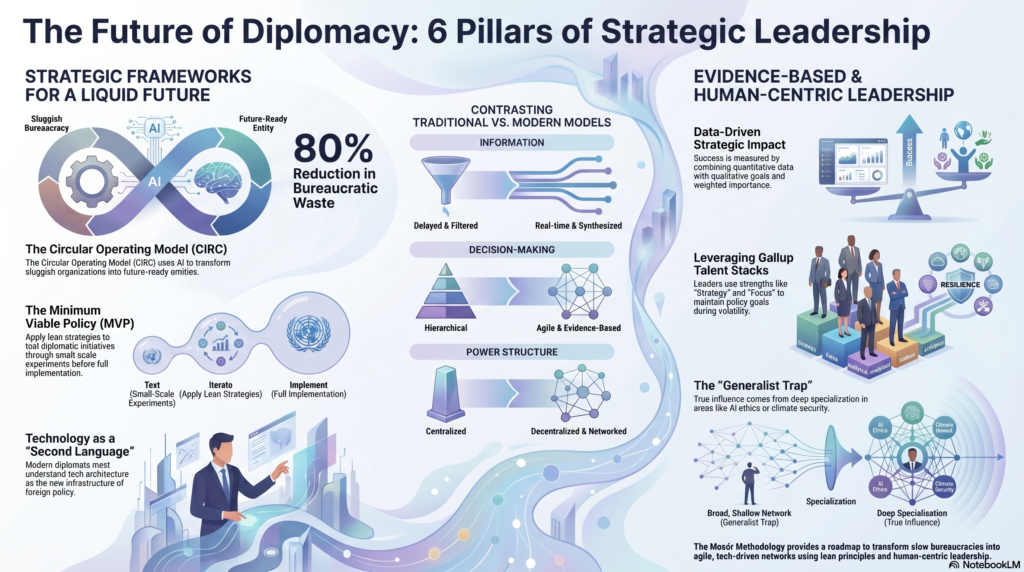
1. Pillar One: From Generalist Trap to Deep Specialization
In the highly volatile, AI-driven “soloeconomy” (or “liquid economy”), the traditional generalist model has become a strategic liability. Generalists fail in this modern environment due to a few critical shortcomings:
- The “Generalist Trap” and the Illusion of Competence: Generalists often rely on a “veneer of competence” that ultimately breaks down when faced with technical complexity. In the past, broad knowledge and the ability to speak in vague protocol might have been enough, but these traits are insufficient for navigating high-stakes, specialized fields such as AI ethics, cryptography, or data-driven security.
- Lack of System-Level Understanding: The modern global landscape relies heavily on technological infrastructure. Generalists fail because they lack the specific “technical vocabulary” required to actually understand and navigate the architecture of the complex systems they attempt to govern or manage.
- Inability to Provide Evidence-Based Results: In a world overwhelmed by information noise, trust and credibility are no longer granted by a general job title. Instead, credibility requires a portfolio of measurable results. Generalists often struggle to quantify their strategic impact with hard data, a fundamental requirement in today’s precision-driven meritocracy.
The Solution: Deep Specialization To survive and thrive in the soloeconomy, professionals must transition away from sluggish, generalized models and embrace deep specialization. Beata Mosór’s methodology notes that specialized individuals are ten times more valuable than generalists because they possess the depth needed to truly maneuver through complex environments.
To escape the generalist trap, leaders are advised to:
- Pick a specific technical domain (such as SQL, R, or AI models for specific usage) and become a deep expert.
- Adopt a “Minimum Viable Policy” (MVP) mindset, taking the smallest possible actions to generate immediate feedback and measurable results before attempting to scale a strategy.
- Build an evidence-based personal brand, utilizing frameworks like the Personal Branding Canvas to clearly define a “Substantive Differentiator.” This requires proving your unique industry expertise with concrete, quantifiable achievements (like revenue growth or user acquisition) rather than relying on general visibility.
2. Pillar Two: Technology as the New Diplomatic Infrastructure
Technology is not an “add-on” to the diplomatic craft; it is the foundational language of 21st-century power. It is the new infrastructure. To conduct effective foreign policy today, a leader must be fluent in the geopolitics of technology. Mastering a “Tech Toolbox” is the only way to eliminate administrative pain points and refocus human capital on high-value strategy.
3. Pillar Three: The Circular Operating Model and Efficiency
To transform sluggish, linear bureaucracies into future-ready entities, leaders must implement the circular, Agile, technology-based operations. This AI-based framework replaces the linear depletion of assets with the continuous reinvestment of knowledge and talent. This model is designed to achieve a radical reduction in time and cost waste—a prerequisite for missions operating in resource-constrained, high-volatility theaters.
Comparative Impact of Operational Models
| Feature | Traditional Bureaucratic Impact | Circular, Lean Model Outcome |
| Process Logic | Linear and Sequential | Circular and Iterative |
| Efficiency | High cost; extreme time consumption | Reduction in waste; AI-led speed |
| Resource Management | Depletion of Human/Financial assets | Continuous reinvestment of Talent/Knowledge |
| Culture | Top-down; rigid protocol | Agile; uses tools like Values Poker for alignment |
4. Pillar Four: Evidence-Based Meritocracy and Precision
In a world of pervasive information noise, trust is built on facts, not headlines. Skepticism is the default; evidence-based leadership is the only antidote. Credibility is no longer a status granted by a title; it is a portfolio of measurable results.
Strategic impact (S) is a calculated result, not an intuitive feeling. Trying to think algorithmically about it, it can be defined by the formula:
S = w1Qn + w2Ql
Where Qn represents quantitative goals (e.g., team size, budget scale), Ql represents qualitative goals (e.g., policy influence, diplomatic sentiment), and w represents the weight of importance. In this meritocracy, you do not “contribute to a project”—you “deliver a $400-participant summit with a 90% stakeholder approval rating.” Precision is the hallmark of the new diplomatic elite.
5. Pillar Five: Human-Centric Leadership and the Talent Stack
The philosophy is simple: Be a leader. Be human. While technology provides the infrastructure, individual human strengths provide the execution. An effective leader’s “Talent Stack” is a unique combination of innate talents leveraged for strategic ends.
The Diplomatic Talent Stack
- Strategy: Mapping complex geopolitical leverage points where others only see chaos.
- Focus: Ensuring long-term policy goals survive short-term political volatility.
- Achiever: The internal drive to bring negotiations to a documented, measurable conclusion.
- Significance: Motivating teams by highlighting the global weight of their mission, building collective resilience during crises.
6. Pillar Six: Recursive Mentorship and Relationship Capital
Relationship capital is the primary currency of diplomacy. In a liquid future, traditional hierarchies fail, but networks endure. To build collective resilience, you must build strong P2P relations & be the mentor you wish you had. Recursive mentorship ensures that your influence outlives your current posting.
The Mentorship Framework:
- Curriculum Building: Designing structured growth paths for junior specialists.
- Feedback Culture: Moving beyond protocol to provide honest, data-driven critiques.
- Succession Planning: Identifying the next generation of AI leaders to ensure organizational continuity.
7. Conclusion: Developing Your Diplomatic Leadership Strategy
Modern diplomacy is technology dressed in values, supported by hard evidence. The industrial era is over; the AI era demands a commitment to lean strategy and human-centric talent development. The “Liquid Future” is not a threat to be feared, but a landscape to be mastered.
Action Checklist for Young Leaders
- [ ]Audit your Talent Stack: Map your strengths to a specific global challenge.
- [ ] Escape the Generalist Trap: Pick one technical domain (SQL, R, AI models for specific usage, etc.) and become an expert.
- [ ] Redesign for Circularity: Identify one linear bureaucratic process and cut its waste.
- [ ] Quantify your Impact: Replace every adjective in your portfolio with data using the S = w1Qn + w2Ql formula.
- [ ] Define the Mission: Establish ethical alignment with your team.
- [ ] Initiate Mentorship: Start building the curriculum for a junior colleague today and look for a mentor for yourself.
Which of these pillars do you find most critical in today’s global landscape? Let’s discuss.
Summary
Strategic Diplomacy
The Mosór Methodology
Assumption 01
Of diplomatic success is derived from pre-negotiation cultural mapping.
Assumption 02
Ratio of civil society engagement vs. formal state protocol.
Assumption 03
The duration of influence when built on shared technological architecture.
The Leadership Matrix
Mapping the five essential competencies of the 21st-century leader according to the methodology.
Power Evolution
The shift from rigid hard power to fluid, data-driven “Smart Power” engagement.
Process Architecture
Phase I: Forensic Contextualization
Deploying cultural intelligence to identify latent friction points and historical narratives that define the current landscape.
Phase II: Asymmetric Networking
Building non-linear alliances across technology sectors, academic institutions, and grassroots movements.
Phase III: Framework Institutionalization
Translating tactical wins into long-term policy structures that utilize shared data protocols as the “glue” of the agreement.
Sources:
Bauman Z. [2006]. Płynna nowoczesność, tłum. T. Kunz. Kraków: Wydawnictwo Literackie.
Christensen C.M., Raynor M.E., McDonald R. [2015]. What Is Disruptive Innovation? „Harvard Business Review”, vol. 93, nr 12, s. 44–53.
Schumpeter J.A. [1942]. Capitalism, Socialism, and Democracy. s 82-84.


