
Soloeconomy 2.1: Decentralized Energy Architecture, Microgrids, and Energy Quanta as the Next Macroeconomic Paradigm
Disclaimer:
Post written by Gemini 3.1. Pro based on my own research materials & gathered data.
Visualizations, models, and frameworks on my own. Video by Gemini.Notebook.
Macroeconomic Reconfiguration: From the Solid Economy to Soloeconomy 2.0
Traditional macroeconomic models operate on a structural foundation composed of four primary institutional pillars: households, enterprise corporations, local municipal authorities, and central state administration. This conventional configuration—frequently designated as the “Solid Economy” – relies on centralized corporate production structures, long-distance utility distribution, and hierarchical wage-labor dynamics. However, the rapid convergence of advanced artificial intelligence (AI) and distributed digital infrastructure has catalyzed an erosion of enterprise-centric production models, shifting the macroeconomic center of gravity toward autonomous individual actors.
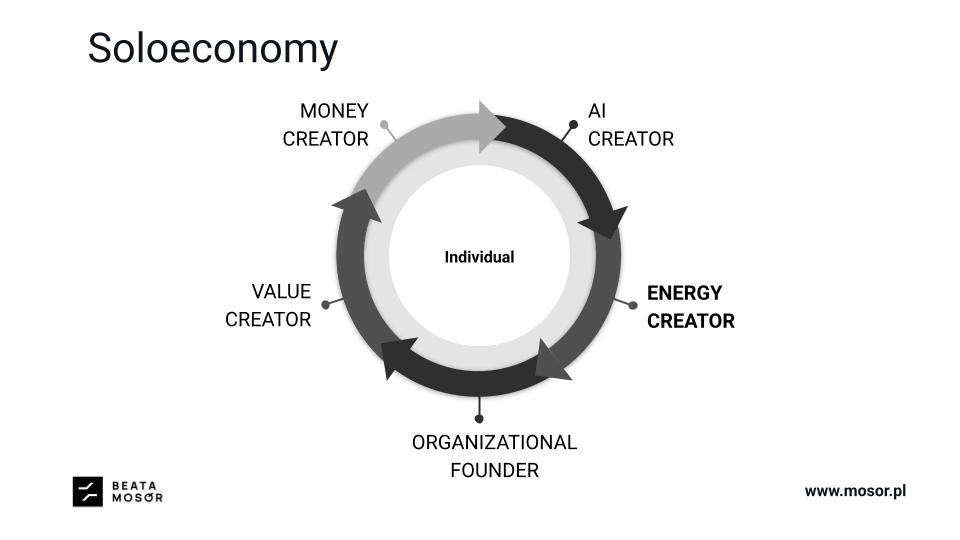
This transformation establishes an emerging economic framework – Soloeconomy 2.0, which introduces a fifth macroeconomic pillar: the individualized, autonomous Solopreneur acting as an active Energy Creator (as one of its roles). Within this framework, generative AI and predictive automation substantially reduce marginal labor costs and intellectual property development friction. As routine cognitive and administrative tasks become automated, human labor ceases to serve as the primary limiting factor of economic production. Consequently, value creation anchors directly directly to two physical and digital fundamentals: raw computing power and available physical energy capacity.
The emergence of Soloeconomy 2.0 is further accelerated by demographic transitions across industrialized nations. Data from Eurostat reveals a structural atomization of societal living arrangements, with single-person households in the European Union reaching 76.1 million – representing a 19.2% expansion over historic baselines. This demographic shift transforms private residential dwellings from passive consumption units into active, sovereign production nodes. Facilitated by remote work and sovereign intellectual capital, the single-person household becomes an integrated operational unit capable of generating high-value intellectual property alongside physical electrical power.
Universal Access Frameworks: Universal Basic Energy (UBE) and Universal Basic Compute (UBC)
As machine intelligence absorbs routine cognitive labor, traditional economic distribution mechanisms reliant on wage employment face structural instability. Conventional policy responses frequently advocate for fiat-denominated Universal Basic Income (UBI) as a stabilizing transfer mechanism. However, macroeconomic analysis within Soloeconomy 2.0 indicates that fiat-based UBI is structurally insufficient and risks exacerbating economic inequality through a condition described as techno-feudalism. Under a techno-feudal structure, central banks issue diluted, debt-backed currency while a concentrated oligopoly of technology conglomerates retains exclusive ownership of foundational computing infrastructure, advanced AI models, and energy generation assets.
To preserve economic agency, individual sovereignty, and distributional equity, the macroeconomic framework that I proposed replaces monetary UBI with two fundamental socio-economic rights: Universal Basic Compute (UBC) and Universal Basic Energy (UBE)1.
| Policy Construct | Primary Medium | Economic Mechanism | Structural Vulnerability and Outcome |
| Universal Basic Income (UBI) | Debt-backed Fiat Currency | Direct monetary transfer to households | Highly susceptible to monetary inflation; preserves techno-feudal concentration of capital assets. |
| Universal Basic Compute (UBC) | Processing Capacity / FLOPS | Guaranteed direct access to foundational AI models and hardware | Democratizes intellectual production tools; prevents monopolistic computational rent-seeking. |
| Universal Basic Energy (UBE) | Physical Energy Quanta (kWh) | Unalienable baseline access to clean electrical power | Establishes direct ownership of physical productive capacity; guarantees operational sovereignty. |
By establishing UBE and UBC as fundamental human rights, economic policy transitions from redistributing diluted financial tokens to guaranteeing direct access to the physical and computational means of production. This shift ensures that autonomous solopreneurs maintain non-discriminatory access to the raw inputs required to generate value, execute advanced software models, and trade within global peer-to-peer markets.
Physical Architecture: Microgrids, Autonomous Systems, and Vehicle-to-Grid Integration
The shift toward individualized energy creation necessitates a fundamental restructuring of electrical transmission infrastructure. Legacy utility grids remain largely centralized and unidirectional, designed around high-capacity fossil or nuclear generation facilities dispatching power across long distances to passive end-consumers. This historical architecture suffers from inherent operational vulnerabilities, including substantial line transmission losses, susceptibility to severe weather disruption, single-point-of-failure exposure, and high exposure to cyberattacks targeting central utility control nodes.
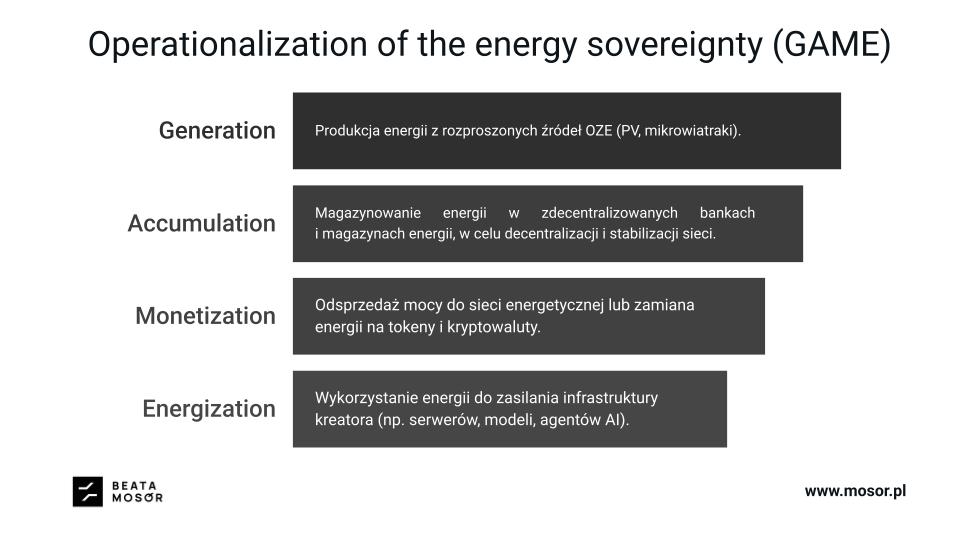
Soloeconomy 2.0 rearchitects power infrastructure into interconnected yet islandable microgrids – localized, autonomous energy ecosystems integrating distributed energy resources (DERs). These production nodes integrate rooftop solar photovoltaics (PV), micro wind turbines, ambient energy harvesting devices, and localized Battery Energy Storage Systems (BESS). Rather than relying on a distant utility power plant, the local residential node generates, stores, and manages its own electrical supply.
A pivotal component of local grid flexibility within this microgrid architecture is Vehicle-to-Grid (V2G) technology. Under legacy ownership frameworks, an electric vehicle (EV) represents a static, depreciating operational expense. Integrated into a smart microgrid, the EV functions as a mobile energy storage asset. The vehicle’s high-capacity battery absorbs surplus renewable power during peak production periods and discharges electricity back into the household microgrid or localized network during periods of high grid demand or elevated spot prices.
Because renewable energy generation is inherently intermittent and weather-dependent, localized physical balancing requires automated real-time optimization. Solopreneur microgrid nodes deploy localized AI management software incorporating Long Short-Term Memory (LSTM) neural networks and metaheuristic optimization algorithms. These autonomous software agents analyze predictive weather models, historical household consumption patterns, battery degradation parameters, and real-time electricity price signals to execute automated energy trading, load shifting, and storage management without requiring human intervention.
Monetary Theory: The Quantization of Value and Energy-Backed Currency
A core theoretical contribution of the Soloeconomy 2.0 model is the reconfiguration of monetary mechanics through the quantization of value. Conventional fiat currencies represent debt obligations issued by central monetary authorities. Because fiat money can be expanded arbitrarily without physical constraints, it acts as a lagging indicator of economic activity and remains subject to long-term purchasing power debasement.
Soloeconomy 2.0 re-anchors economic value in physical thermodynamics. Drawing upon Nicholas Georgescu-Roegen’s foundational application of entropy laws to economic process (1971), energy represents an absolute, immutable constraint on physical and computational transformation. Unlike paper or digital fiat, energy cannot be printed or arbitrarily expanded; its availability is strictly governed by thermodynamic physical laws and entropy degradation.
While early decentralized protocols like Bitcoin demonstrated that energy expenditure could generate algorithmic trust via Proof-of-Work (PoW), traditional PoW mechanisms remain ecologically inefficient due to arbitrary, non-functional mathematical hashing. Soloeconomy 2.0 transitions network consensus toward Proof of Impact (PoI) and Proof of Useful Work (PoUW) based on wel–known mechanismscoming from the cryptography market.
| Consensus Mechanism | Underlying Resource Input | Functional Operational Output | Economic and Environmental Utility |
| Proof-of-Work (PoW) | Electrical Power & ASIC Hardware | Arbitrary, non-functional cryptographic hashes | High energy consumption; zero direct real-world computational output. |
| Proof of Impact (PoI) | Clean Energy & High-Performance Compute | Verifiable resolution of complex scientific or societal problems | Direct utility; converts energy into actionable human knowledge and climate modeling. |
| Regenerative Reputation | Verified Ecological & Scientific Contributions | Non-transferable digital identity capital | Establishes non-monetary credit based on net positive network impact. |
Under a Proof of Impact consensus, computational cycles and electrical energy are directed exclusively toward addressing complex global challenges, including climate system modeling, epidemiological forecasting, molecular drug discovery, and advanced materials engineering. Participants who supply clean energy and compute capacity to solve these targeted problems earn Regenerative Reputation – a non-transferable, identity-linked digital asset that dictates network status, priority compute access, and market transaction settlement rights. Bilateral, friction-free transactions between microgrid operators are automatically executed via smart contracts on Distributed Ledger Technology (DLT), bypassing traditional commercial banking intermediaries.
Legislative and Regulatory Frameworks in the European Union
The practical implementation of Soloeconomy 2.0 aligns with legislative initiatives designed to liberalize energy markets and facilitate consumer-led energy generation across the European Union. The primary regulatory groundwork stems from the EU Clean Energy for all Europeans Package, specifically Directive (EU) 2019/944 on common rules for the internal market in electricity (IMED) and Directive (EU) 2018/2001 on the promotion of the use of energy from renewable sources (RED II). These directives established formal legal definitions across Member States for active customers, Citizen Energy Communities (CEC), and Renewable Energy Communities (REC), establishing statutory rights for end-users to generate, store, consume, and trade self-generated electricity.
This legal framework was updated through Directive (EU) 2024/1711 of the European Parliament and of the Council, which reformed the Union’s electricity market design. Directive (EU) 2024/1711 strengthens energy-sharing rights by establishing explicit provisions for active customers:
- Statutory Energy-Sharing Entitlements: Active customers are legally authorized to share self-generated renewable electricity through private peer-to-peer agreements or established legal entities, provided that energy sharing does not constitute their primary commercial enterprise.
- Contractual Protections: Member States must enforce regulations preventing electricity suppliers from unilaterally modifying or terminating fixed-term, fixed-price supply contracts when consumers choose to participate in energy-sharing or demand-response programs.
- Supplier Compliance Exemptions: Household energy-sharing arrangements operating generation installations with an installed capacity up to 10.8 kW for single residential dwellings (and up to 50 kW for multi-apartment buildings) are fully exempt from standard energy supplier administrative obligations.
- Capacity Caps and Geographical Scope: Energy-sharing generation facilities are permitted up to a maximum total capacity of 6 MW, operating within localized geographical boundaries defined by individual Member States.
- Establishment of Energy Sharing Organizers: Active customers may designate a third-party “energy sharing organizer” to manage administrative communication, tariff calculations, metering data, and grid operator interactions without relinquishing their underlying consumer protection rights.
Concurrently, the integration of automated AI agents managing energy routing intersects with the European Union AI Act. Because power grid operations constitute critical national infrastructure, algorithmic systems deployed to manage microgrid load balancing, real-time dispatch, and frequency stabilization are designated as high-risk AI systems. As a result, software developers and system operators must ensure compliance with strict standards regarding algorithmic transparency, data governance, cybersecurity resilience, and continuous human oversight.
Geopolitical Bottlenecks and Material Constraints: The “Rocks of AI”
While the structural design of Soloeconomy 2.0 enhances macro-level resilience against centralized energy failures, its physical execution encounters severe material limitations known as the “Rocks of AI”. A fundamental structural tension exists within the green and digital transition: while AI control software, microgrid trading protocols, and smart contracts can be decentralized globally, the underlying hardware infrastructure relies on hyper-centralized, geostrategically vulnerable mineral extraction and refining supply chains.
The physical deployment of localized photovoltaic systems, battery energy storage systems, advanced power electronics, and high-performance computing hardware demands vast quantities of Critical Raw Materials (CRMs), including Gallium, Germanium, Copper, Lithium, Cobalt, Nickel, and Rare Earth Elements (REEs).
| Critical Raw Material | Global Supply Concentration Stats | Primary Technology Application | Systemic Impact of Supply Disruption |
| Gallium | China controls ~98% of global raw production. | Power electronics, high-efficiency photovoltaics, microchips. | CSIS models estimate a 30% supply disruption costs the US economy $602B (2.1% GDP loss). |
| Germanium | China controls ~60% of refined production. | Fiber optics, infrared sensors, advanced semiconductors. | Impairs deployment of advanced sensor networks and optical telecom hardware. |
| Magnesium | EU imports ~95% of supply from China. | High-strength aluminum alloys for automotive and structural hardware. | Vulnerability in manufacturing lightweight microgrid structures and electric vehicle frames. |
| Cobalt | ~75% mined in DRC; ~60% refined in China. | High-density lithium-ion BESS and electric vehicle battery chemistry. | Severe battery production bottlenecks and energy storage cost inflation. |
| Copper | Projected 30% global deficit by 2035 (USGS/IEA). | Electrical wiring, power transformers, inverter components, microgrid lines. | Creates a physical ceiling on microgrid electrification and transmission expansion. |
To mitigate these geopolitical vulnerabilities, the European Union enacted Regulation (EU) 2024/1252, known as the Critical Raw Materials Act (CRMA). The CRMA establishes legally binding targets for strategic raw materials to be achieved across the Union by 2030:
- Extraction Capacity: At least 10% of the Union’s annual consumption of strategic raw materials must originate from domestic extraction within the EU.
- Processing Capacity: At least 40% of the Union’s annual consumption of strategic raw materials must be processed within EU Member States.
- Recycling Capacity: At least 25% of the Union’s annual consumption of strategic raw materials must be met through domestic recycling and waste recovery streams.
- Supply Diversification Limit: No more than 65% of the Union’s annual consumption of any single strategic raw material at any relevant stage of processing may originate from a single third country.
The CRMA accelerates project deployment by streamlining administrative permitting for designated Strategic Projects, setting statutory maximum timeframes of 27 months for extraction permits and 15 months for processing or recycling authorizations. Additionally, Article 24 of the CRMA requires large enterprises operating in key sectors – such as renewable energy generation, advanced semiconductor manufacturing, and digital communications – to perform regular supply chain risk assessments every three years to map strategic mineral origins and identify vulnerability vectors.
System Dynamics and Strategic Policy Imperatives
The evolution toward Soloeconomy 2.0 operates as a complex, multi-order feedback system across economic, technological, and regulatory domains. As AI models reduce the marginal cost of intellectual production, the workforce increasingly shifts toward sovereign, single-person business entities. This societal atomization drives residential demand for sovereign energy generation, accelerating the adoption of home photovoltaics, localized BESS, and V2G electric vehicles.
As microgrids proliferate, the technical challenge shifts from central energy generation to local grid balancing and peer-to-peer energy settlement. This requirement necessitates automated market systems governed by smart contracts and DLT, triggering a conceptual shift from debt-backed fiat money toward energy-backed tokens constrained by thermodynamic entropy. However, as millions of microgrid nodes and compute clusters are deployed globally, the demand for specialized hardware runs directly into physical mineral shortages and geopolitical export controls – the “Rocks of AI”. These material limits compel state actors to enact industrial interventions like the EU Critical Raw Materials Act, closing the loop between individual solopreneur sovereignty and national strategic policy.
To successfully navigate this economic transformation while avoiding supply bottlenecks and market failures, economic policy and industrial strategies must focus on four key areas:
- Rapid Expansion of Domestic Processing and Circular Recycling: European industrial policy must prioritize funding for secondary mineral recycling infrastructure and strategic refining capacity under Regulation (EU) 2024/1252. Strengthening circular e-waste recycling for permanent magnets, circuit boards, and battery components is essential to offset primary mineral import dependencies.
- Harmonization of Transnational Energy-Sharing Protocols: Member States must swiftly implement the provisions of Directive (EU) 2024/1711 into domestic law. Standardizing technical and administrative frameworks for energy sharing organizers will reduce market entry barriers for small prosumers and ensure non-discriminatory grid access.
- Regulatory Verification of Algorithmic Infrastructure: Because microgrid balancing software falls under the high-risk categorization of the EU AI Act, regulators must establish standardized testing protocols for autonomous LSTM and metaheuristic trading agents. Ensuring algorithmic resilience against market manipulation, voltage instability, and cyber threats is critical for system reliability.
- Standardization of Proof of Impact Consensus Metrics: Decentralized networks and research institutions should collaborate to standardize Proof of Impact protocols. Codifying how scientific processing and environmental remediation map to cryptographic token issuance will ensure that energy expenditure translates directly into high-value societal research and measurable planetary remediation.
By systematically addressing these physical, technological, and regulatory dependencies, the Soloeconomy 2.0 paradigm provides an effective framework for aligning technological decentralization, environmental sustainability, and individual economic sovereignty within a resilient modern economy.
Cytowane prace
- Dagg, J. [2025]. Basic Income for the Arts in Ireland: Qualitative evaluation report. Maynooth: Maynooth University Department of Sociology. https://catalogus.boekman.nl/pub/BIA_Report_2025.pdf [7.08.2026 r.].
- Dyrektywa Parlamentu Europejskiego i Rady (UE) 2019/944 z dnia 5 czerwca 2019 r. w sprawie wspólnych zasad rynku wewnętrznego energii elektrycznej oraz zmieniająca dyrektywę 2012/27/UE. Dziennik Urzędowy Unii Europejskiej, L 158/125. Pobrane z: EUR-Lex.
- Dyrektywa Parlamentu Europejskiego i Rady (UE) 2018/2001 z dnia 11 grudnia 2018 r. w sprawie promowania stosowania energii ze źródeł odnawialnych. Dziennik Urzędowy Unii Europejskiej, L 328/82. Pobrane z: EUR-Lex.
- Georgia Kakoulaki, Robert Kenny, Nigel Taylor, Ana Maria Gracia-Amillo, Sandor Szabo, Ana M. Martínez, Christian Thiel & Arnulf Jäger-Waldau, Mapping Europe’s rooftop photovoltaic potential with a building-level database., Nature Energy volume 11, pages 324–333 (2026).
- Elsevier [2022]. Optimal energy management in a microgrid under uncertainties using hybrid metaheuristic and LSTM-RNN models. Applied Energy, 312, 118–130. ScienceDirect Applied Energy [7.08.2026 r.].
- Eurofound [2020]. Living, working and COVID-19 (Research Report). Publications Office of the European Union. https://www.eurofound.europa.eu/en/publications/all/living-working-and-covid-19 [7.08.2026 r.]
- Eurostat [2025a]. Household composition statistics. Luxembourg: Statistics Explained, https://ec.europa.eu/eurostat/statistics-explained/index.php?title=Household_composition_statistics [28.05.2026 r.].
- Eurostat [2025b]. Marriage and divorce statistics. Luxembourg: Statistics Explained, https://ec.europa.eu/eurostat/statistics-explained/index.php?title=Marriage_and_divorce_statistics [28.05.2026 r.].
- Funaiole, M. P., Hart, B., & Powers-Riggs, A. (2023). De-risking Gallium Supply Chains: The National Security Case for Eroding China’s Critical Mineral Dominance. Center for Strategic and International Studies (CSIS). CSIS Research Report
- Georgescu-Roegen, N. [1971]. The Entropy Law and the Economic Process, Cambridge, MA: Harvard University Press.
- Hardy, Q. [2023]. AI Oracles and Goodhart’s Law: Designing resilient reward functions in decentralized networks. Artificial Intelligence and Economic Theory, 12(2).
- Kumari, A., Chintukumar Sukharamwala, U., Tanwar, S., Raboaca, M. S., Alqahtani, F., Tolba, A., Sharma, R., Aschilean, I., & Mihaltan, T. C. [2022]. Blockchain-Based Peer-to-Peer Transactive Energy Management Scheme for Smart Grid System. Sensors, 22(13), 4826. https://doi.org/10.3390/s22134826
- Kumari, A., Tanwar, S., Tyagi, S., & Kumar, N. [2019]. Verification and transaction optimization in smart grid architectures. IET Networks, 8(3)
- Landau, L. D., & Lifshitz, E. M. [2011]. Mechanika kwantowa: Teoria relatywistyczna. Wydawnictwo Naukowe PWN.
- Liu, T.; Tan, X.; Sun, B.; Wu, Y.; Guan, X.; Tsang, D.H.K. [2015] Energy management of cooperative microgrids with P2P energy sharing in distribution networks. In Proceedings of the 2015 IEEE International Conference on Smart Grid Communications (SmartGridComm), Miami, FL, USA, 2–5 November 2015; pp. 410–415. [Google Scholar] [CrossRef]
- Mosór B. [2026a]. Soloekonomia – dysrupcja modelu ekonomicznego w dobie AI., Kraków: Biuletyn PTE nr 2/2026.
- Mosór B. [2026b] The Liquid Future: Is AI Economy the Soloeconomy?, Kraków: www.mosor.pl.
- Mosór B. [2026c] Soloeconomy 2.0.: The New Social Contract, Kraków: www.mosor.pl.
- Nakamoto S. [2008]. Bitcoin: A Peer-to-Peer Electronic Cash System.
- Nature Portfolio [2025]. Optimizing solar power forecasting with metaheuristic algorithms and deep recurrent networks. Scientific Reports, 15, Artykuł 23822. https://www.nature.com/articles/s41598-025-23822-1 [7.08.2026 r.]
- Reuter E., Loock M., Cousse J. [2019]. Digital Business Models for Local and Micro Power Markets. (w:) Micro and Local Power Markets.
- Rozporządzenie Parlamentu Europejskiego i Rady (UE) 2024/1689 z dnia 13 czerwca 2024 r. ustanawiające zharmonizowane przepisy dotyczące sztucznej inteligencji (akt w sprawie sztucznej inteligencji). Dziennik Urzędowy Unii Europejskiej, L 2024/1689. Pobrane z: Komisja Europejska.
- Rozporządzenie Parlamentu Europejskiego i Rady (UE) 2024/1252 z dnia 11 kwietnia 2024 r. ustanawiające ramy na potrzeby zapewnienia bezpiecznych i zrównoważonych dostaw surowców krytycznych. Dziennik Urzędowy Unii Europejskiej, L 2024/1252. Pobrane z: Komisja Europejska.
- Schneider Electric. [2021]. Microgrid Energy Management System Integration with ADMS. Schneider Electric Smart Grid Global Research. Schneider Electric Solutions
- Siemens. [2023]. Decentralized Energy Management System (DEMS) in Microgrids: Technical Architecture and Load Response Report. Siemens Smart Infrastructure. Siemens Solutions
- ScienceDirect [2026]. LSTM forecasting, hybrid GA–PSO dispatch, and adaptive control for renewable-rich smart microgrids. Journal of Energy Storage Systems, 44(2), 102–115. https://www.sciencedirect.com/science/article/abs/pii/S2210537926000703 [7.08.2026 r.]
- UN General Assembly [2010]. The human right to water and sanitation, Resolution A/RES/64/292, New York: United Nations. https://digitallibrary.un.org/record/687002 [7.08.2026 r.]
- U.S. Geological Survey. [2024]. Gallium: Minerals Yearbook 2020. U.S. Department of the Interior. USGS Publications.
- Vaswani A. i in. [2017]. Attention Is All You Need. (w:) Advances in Neural Information Processing Systems 30 (NIPS 2017).
- International Energy Agency. [2026]. Global Critical Minerals Outlook 2026. IEA. IEA Reports
- Yano, M., Dai, C., & Masuda, K. [2020]. Blockchain Technology and Institutional Design. Springer Singapore. doi.org
- Regulatory Aspects of Self- Consumption and Energy Communities – CEER, https://www.ceer.eu/wp-content/uploads/2024/04/C18-CRM9_DS7-05-03_Report-on-Regulatory-Aspects-of-Self-Consumption-and-Energy-Communities_final.pdf
- STATUTORY INSTRUMENTS. S.I. No. 76 of 2022 EUROPEAN UNION (RENEWABLE ENERGY) REGULATIONS 2022, https://www.irishstatutebook.ie/eli/2022/si/76/made/en/pdf
- L_2023130EN.01000101.xml – EUR-Lex – European Union, https://eur-lex.europa.eu/legal-content/EN/TXT/HTML/?uri=CELEX:32023R0955
- Article 2 | openlaws, https://admin.lawthek.eu/detail/d7dab626-c372-4f6e-8e4d-bc763a0fa481/en/
- Shared Energy Use Under the New Electricity Industry Act (ElWG) – CMS.law, https://cms.law/en/aut/legal-updates/shared-energy-use-what-opportunities-does-the-elwg-create
- L_202401711EN.000101.fmx.xml – EUR-Lex, https://eur-lex.europa.eu/legal-content/EN/TXT/HTML/?uri=OJ:L_202401711&qid=1781788715681
- Critical Raw Materials Act Practical Guide 2026 – Enviropass Expertise Inc., https://getenviropass.com/critical-raw-materials/
- The EU Critical Raw Materials Act and Its Impact on the Mining Sector: Strategic Opportunities for Industry Stakeholders | Insights | Jones Day, https://www.jonesday.com/en/insights/2026/05/the-eu-critical-raw-materials-act-and-its-impact-on-the-mining-sector-strategic-opportunities-for-industry-stakeholders


